When most people hear "real estate deal," they picture someone buying a house. Assignment of contract is different. You're not buying the house. You're buying the right to buy it — and then selling that right to someone else before you ever close.
That's the entire mechanic. It's the legal foundation of wholesaling, and understanding how it works is step one before you do your first deal.
The plain-language version
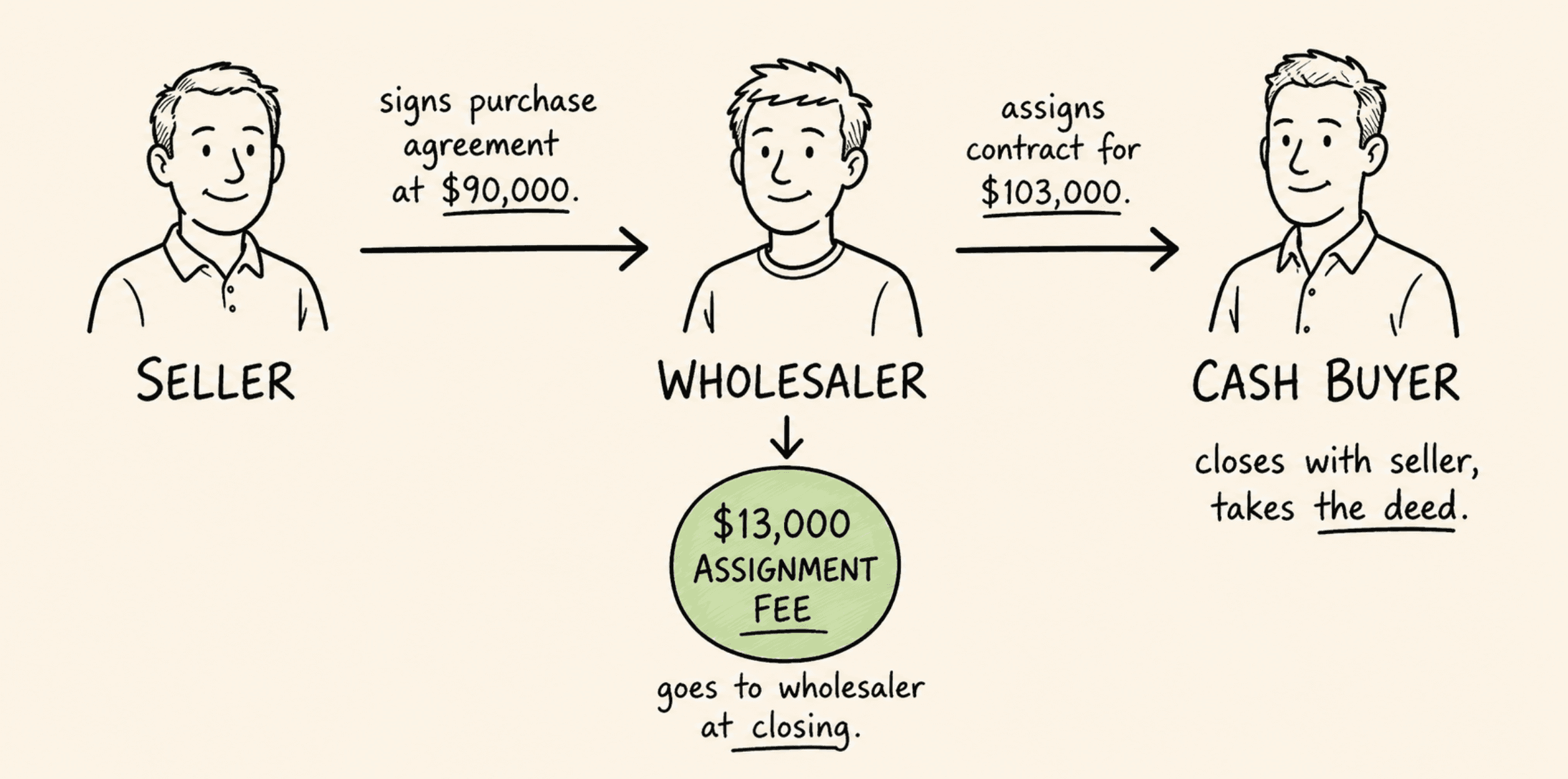
You find a distressed property. The seller wants out. You sign a purchase agreement to buy it for, say, $90,000. That contract gives you the legal right — called equitable interest — to purchase the property at that price.
You don't close on it. Instead, you find a cash buyer who wants the deal. They pay you $103,000 for the contract — your $90,000 purchase price plus a $13,000 assignment fee. They step in, close with the seller, and you collect $13,000 at closing without ever appearing on the deed.
You sold a piece of paper. The paper was worth $13,000 because you found a deal nobody else had.
The two documents involved
Every assignment deal uses two separate contracts, not one. New wholesalers often get confused here.
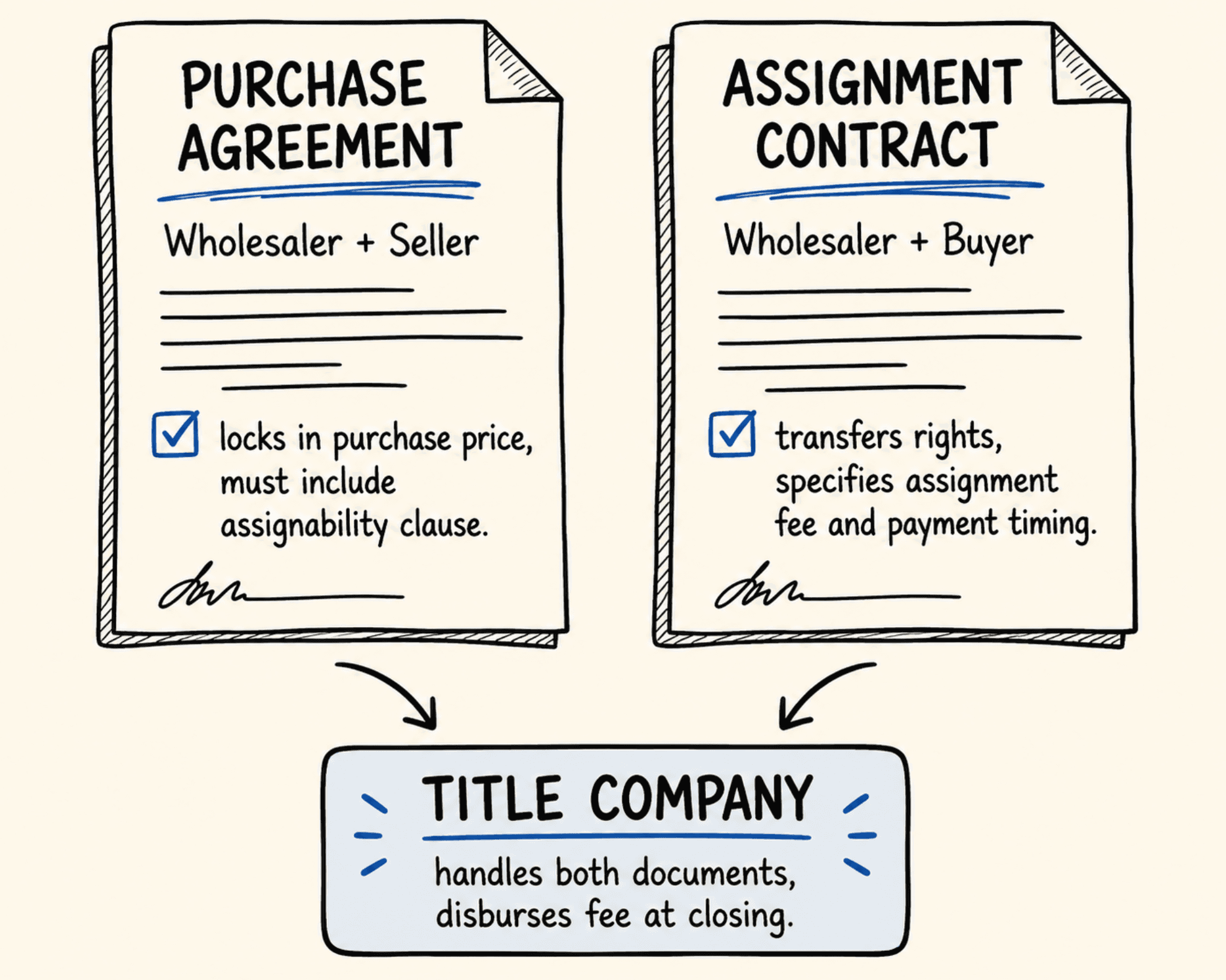
The purchase agreement is signed between you and the seller. It locks in the purchase price, the closing date, and any contingencies. It must include an assignability clause — language that explicitly allows you to transfer your rights to another buyer. Without that clause, the contract may not be assignable.
The assignment contract is signed between you and your end buyer. It transfers your rights under the purchase agreement to them in exchange for your assignment fee. It specifies the fee amount, payment timing, and what happens if the deal falls apart.
Both documents go to the title company. The title company handles the closing, confirms the seller gets their $90,000, confirms you get your $13,000 fee, and confirms the buyer takes the deed. You sign once and collect. The buyer and seller show up at closing.
Equitable interest
When you sign a purchase agreement, you don't own the property, but you have equitable interest in it. That's a legal term for your contractual right to purchase. It's what you're marketing and selling, not the physical house.
This distinction matters legally, though exactly how strict it is depends on the state. Some states scrutinize the specific language you use to market a deal closely, others care more about whether you're representing yourself as a licensed agent at all. The one rule that holds everywhere: be clear you're marketing your right to buy the contract, not acting as if you're a licensed agent selling the house on the seller's behalf. In states that regulate this closely, that means avoiding language like "I have a property for sale at 123 Main St" in favor of something like "I have a contract to purchase 123 Main St that I'm looking to assign." In states with lighter restrictions, the exact wording matters less, but the underlying line, contract versus property, still determines whether you're operating as a wholesaler or stepping into unlicensed brokering.
Assignment vs. double close, when to use each
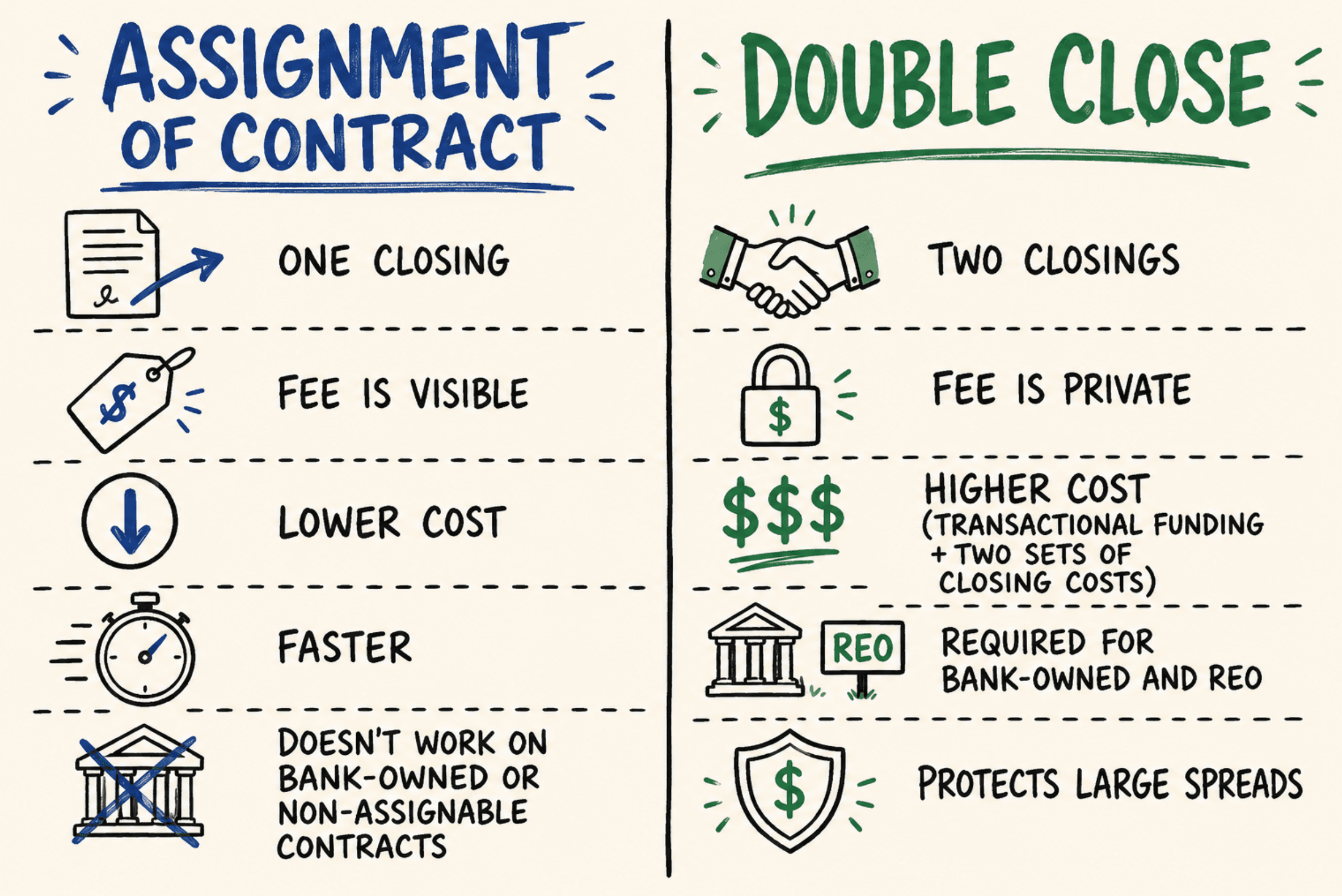
Assignment of contract is the faster, cheaper, simpler exit. One closing, one set of closing costs paid by the buyer, and your fee is collected at the table. The tradeoff: your fee is visible to everyone, the seller, the buyer, and the title company all see the numbers.
Most sellers don't care. Some do. A seller who agreed to $90,000 and then sees that someone is buying it for $103,000 might push back. Many experienced wholesalers explain their fee upfront and build it into the relationship from the start, though plenty don't, and that gap is exactly what causes the pushback in the first place. Sellers who feel blindsided cause problems. Sellers who understand the arrangement going in usually don't.
A double close solves the visibility problem by splitting the transaction into two separate closings: you buy from the seller and immediately resell to the buyer, sometimes the same day. Your profit is embedded in the price difference and never appears on a single closing statement. It's also required when the original contract prohibits assignment, common with bank-owned properties, MLS listings, and some REO assets.
The tradeoffs: two sets of closing costs, transactional funding fees of 1.5-2.5% to fund the first leg, more complexity, and a higher bar to execute cleanly. Most beginners default to assignments because they're cheaper. Experienced investors use double closings when needed to protect massive spreads.
When assignment doesn't work
Three situations where you can't assign and need to double close or walk away:
The contract prohibits it. Bank-owned properties, HUD homes, and many MLS contracts include anti-assignment language. Read every contract before you sign. If it says "this contract is not assignable" and you haven't negotiated that out, you're done.
The buyer's lender won't fund it. Cash buyers don't have this problem. But if your end buyer is using financing — even hard money — some lenders won't fund an assignment. Confirm how your buyer is funding before you lock up the deal.
State law restricts it. A few states have tightened the rules significantly. Illinois, Oklahoma, and South Carolina have the strictest rules in 2026, often requiring licensure. Texas requires disclosure under SB 1577 but does not prohibit the activity. We covered the full state-by-state legal picture in Is Wholesaling Real Estate Legal? — worth reading before you operate in a new market.
The assignment fee
Your assignment fee is the spread between your contract price and what your buyer pays for the contract. There's no legal cap on how much you can charge — the market caps it. A buyer will pay up to the point where the deal still pencils for them. Past that, they pass.
Most residential assignment fees run $5,000-25,000, with the national average around $13,000. First deals typically land in the $5,000-10,000 range — competitive enough to get a buyer interested, wide enough to be worth doing. Chasing a $40,000 fee on your first deal without an established buyer relationship usually means an expired contract and a deal that never closes.
The fee gets paid at closing through the title company. You don't collect it directly from the buyer and you don't collect it before closing. It's disbursed from the title company after closing.
For how to set the number and explain it to sellers, see Real Estate Assignment Fee.
The legal picture in 2026
Assignment of contract is legal in all 50 states. How it's regulated varies significantly and changed substantially in 2025-2026.
Five states enacted new wholesaling laws in 2025. Oklahoma now requires written disclosures before signing and a two-business-day cancellation right for sellers. Tennessee requires three specific disclosures in bold font. Maryland requires two written disclosures, one to the seller, one to the buyer, and non-compliance gives sellers unconditional rescission rights. North Dakota and Nebraska don't require a license to wholesale, but public marketing of your equitable interest does, in Nebraska outright, in North Dakota through disclosure requirements. Practically, that means lining up your buyer before you lock up the property, rather than marketing the contract publicly and hoping one shows up. Connecticut requires registration with the Department of Consumer Protection starting July 1, 2026.
The common thread across all of them: tell sellers clearly what you're doing, that you intend to assign the contract, and that you intend to profit. Sellers who understand the arrangement don't feel exploited. Sellers who feel blindsided after the fact are where regulatory complaints come from.
Before you do your first deal in any state, verify the current rules. Laws that weren't on the books 18 months ago are now in effect, and more states are watching. The full rundown is in New Wholesaling Laws in 2026.
What makes a deal worth assigning
The assignment fee is only collectible if the deal pencils for your buyer. That means your ARV needs to be accurate, your repair estimate needs to be real, and your contract price needs to leave enough room for the buyer's profit after the 70% rule.
A buyer who runs their own comps and finds a different ARV than the one you used isn't going to close at your price. They'll either renegotiate or walk. This is why the numbers you build before you lock up the contract determine whether the assignment is worth anything.
ChatARV runs the comps, calculates ARV from actual sold data, and outputs your MAO with your assignment fee already factored in — so the contract price you bring to a seller is one a buyer can validate.
Run your numbers before your next offer
ChatARV pulls sold comps, calculates ARV, and outputs your MAO with your assignment fee already factored in.