The assignment fee is where most wholesalers either make the deal or lose it. The number is usually fine. The problem is the conversation, specifically, the one you weren't prepared for when the seller sees what you're making.
This article covers what the fee actually is, how to calculate it correctly, what real numbers look like across different markets, and how to handle it when a seller pushes back.
What an assignment fee is
When you wholesale a property, you sign a purchase agreement with the seller and then assign that contract to a cash buyer before closing. The assignment fee is the difference between what you contracted to pay the seller and what the buyer pays you for the contract.
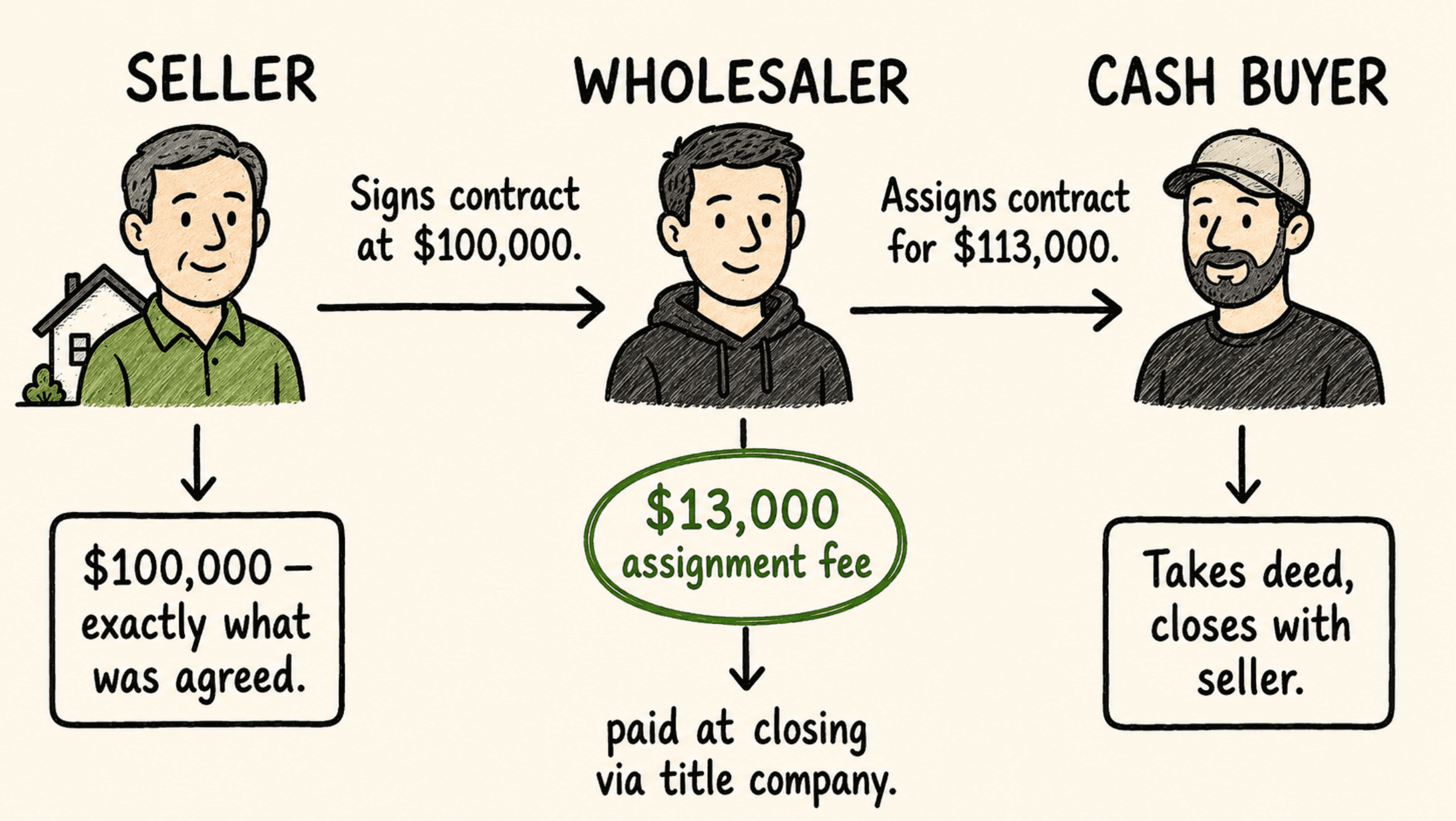
Concrete example: you sign a contract to buy a property for $100,000. You assign that contract to a cash buyer for $113,000. Your assignment fee is $13,000. The seller gets their $100,000. The buyer gets the deal. You collect $13,000 at closing through the title company without ever appearing on the deed.
You're not being paid for the property. You're being paid for finding it, negotiating the contract, and connecting the right buyer to the right deal. That's a legitimate service with real value — and it's worth being clear about that both in your own head and in conversations with sellers.
How much to charge
The average wholesale assignment fee nationwide is $13,000, ranging from $5,000 in Arizona to $22,000 in North Carolina and Georgia. Most first deals land in the $5,000-10,000 range, competitive enough to attract buyers and wide enough to be worth doing.
The right fee isn't a number you pick in advance. It's the output of the deal math.
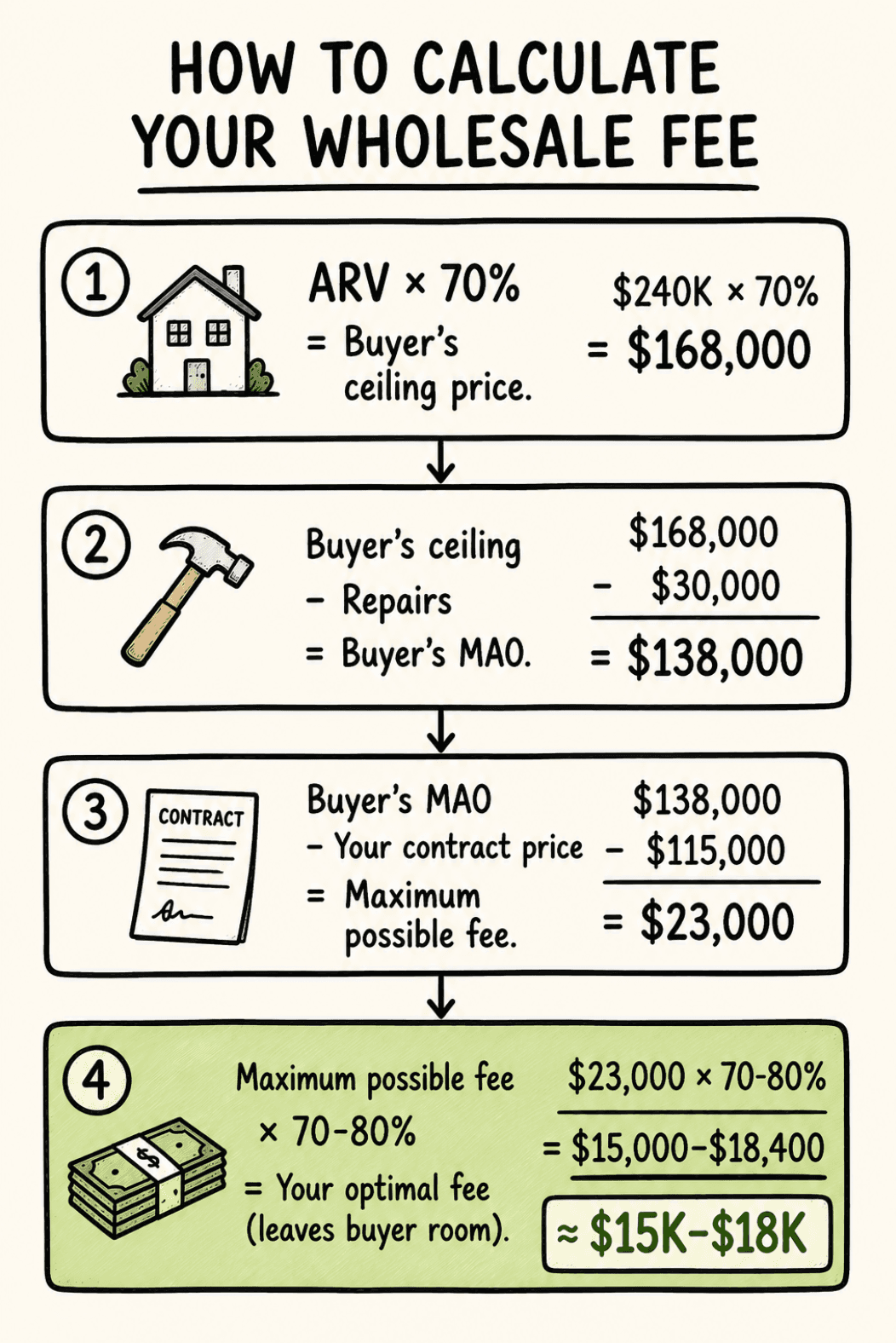
Here's how it works: your buyer has a maximum they'll pay based on their own acquisition formula, typically a percentage of ARV minus repair costs, though the exact threshold varies by buyer and market. That's their ceiling. Your contract price is your floor. Your maximum possible fee is the gap between those two numbers.
Your optimal fee is the highest amount that still allows the deal to sell quickly, ideally within 48-72 hours of presenting it to buyers. Leaving some room below the buyer's maximum makes your deal more attractive and generates faster responses. A deal priced at the absolute ceiling of what buyers will pay sits. A deal priced with room moves.
Worked example: ARV $240,000, repairs $30,000, buyer MAO $138,000. Your contract price $115,000. Maximum possible fee $23,000. Optimal fee $15,000-18,000, leaving the buyer room to work with and still producing a meaningful paycheck.
The factors that move the number up or down:
Market. In competitive wholesale markets like Houston, Atlanta, Phoenix, and Dallas, average fees tend to be higher because deal volume is higher and buyers are more active. In smaller markets fees may be lower but competition is also lower.
Deal quality. A property with a wide spread, bought well below ARV with manageable repairs, supports a higher fee. A thin deal doesn't. The fee reflects how well you bought.
Your buyer relationship. A buyer who trusts your numbers, knows your deals close, and has worked with you before is more willing to pay a higher fee. A new buyer with no history with you is more likely to scrutinize every dollar.
Your experience level. New wholesalers sometimes walk into deals thinking, "I want to make $15,000 on this" without looking at the full picture. That's a fast way to lose the deal, lose the seller's trust, or get stuck with a contract you can't assign. Early deals: take the smaller fee, build the relationship, get the deal closed. The bigger fees come with volume and reputation.
When the seller finds out about your fee
Some sellers, when they see your assignment fee at closing or find out about it beforehand, push back hard. "Wait, you're making $15,000 on my house?"
In most states, you're not required to disclose your fee upfront, and most experienced wholesalers don't. The seller agreed to a price. That price doesn't change. What you make on top of it is your business.
The exception is Tennessee, Maryland, and Oklahoma, where disclosure is legally required. If you're operating in those states, tell the seller upfront before the contract is signed.
Everywhere else, the conversation only comes up if the seller sees the fee on the closing statement or hears about it through the title company. That's where you need to be prepared.
How to handle it when a seller pushes back on the fee
Some sellers push back once they understand what you're making. Here's how to handle it without folding and without getting defensive.
Don't apologize for the number. The fee reflects real work: finding the deal, negotiating the contract, qualifying buyers, managing the closing process. If you lead with "sorry, I know it seems like a lot," you've already undermined yourself.
Explain what you're being paid for, not what you're being paid. The seller needs to understand that your fee comes from the buyer, not from their proceeds. Their number doesn't change.
"What you're getting at closing is exactly what we agreed to, $100,000. The buyer is paying $113,000 for the contract. The $13,000 difference is how I get paid for putting the deal together. It comes from them, not from you."
If they still push back, ask what would make it feel fair. Sometimes sellers just need to voice the concern. Asking "what would make this feel right to you?" often reveals they don't have a specific number in mind.
Know your walk-away number before the conversation starts. If the seller wants you to cut your fee to a point where the deal no longer makes sense, be willing to walk. Leave enough margin so both buyer and seller feel like they won, but if the numbers don't work, walk away cleanly rather than reduce your fee to zero.
When the fee is visible vs. hidden
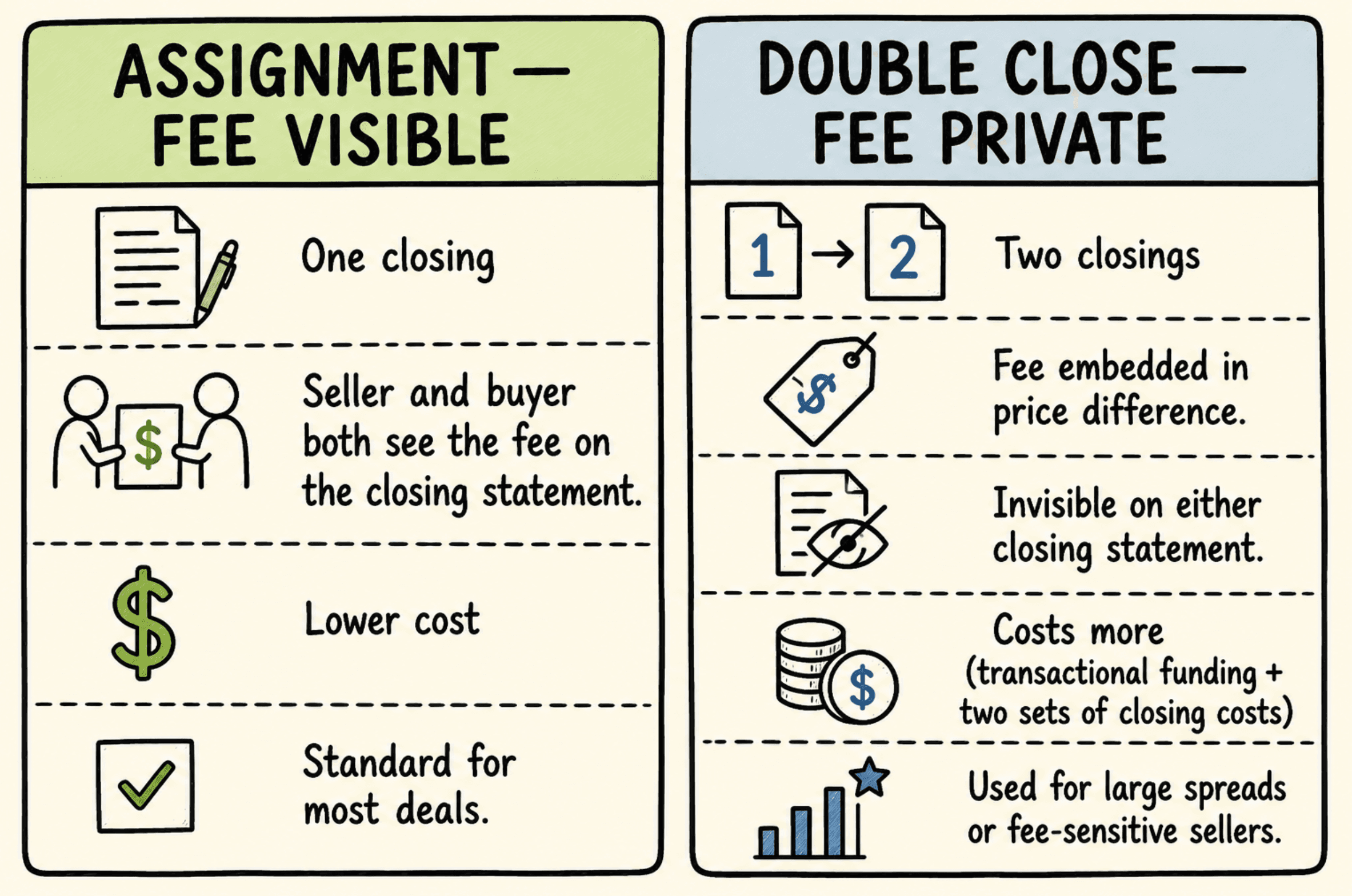
In a standard assignment, everyone at the closing table can see your fee. The seller knows. The buyer knows. The title company knows.
In a double close, your fee is embedded in two separate transactions and stays invisible. You buy from the seller, immediately resell to the buyer, and the spread between those two prices is your profit — shown on neither closing statement as a "fee."
Double closing costs more — two sets of closing costs, transactional funding for the first leg — but it solves the fee visibility problem on large spreads where a seller seeing a $30,000+ fee might create friction. Most experienced wholesalers use assignment on standard deals and double close when the spread is large or the seller is particularly sensitive to it.
The number that actually matters
The fee is only worth protecting if the deal closes. A $20,000 fee on a contract nobody will buy is $0. A $10,000 fee on a deal that closes in three days is $10,000.
That means your ARV needs to be accurate, your repair estimate needs to be real, and your contract price needs to leave enough room for your fee and the buyer's margin. ChatARV runs the comps, calculates ARV from actual sold data, and outputs your MAO with your fee already factored in — so the number you bring to the seller is one that actually has a buyer on the other end of it. Run your numbers here.