
Wholesaling is the fastest way to profit from real estate without using any cash. You find a distressed property, get it under contract below market value, and sell that contract to a cash buyer. Your profit is the spread between those two numbers. You never own the property, never get a mortgage, never manage a renovation.
Here's how it works end-to-end.
What a wholesaler actually does
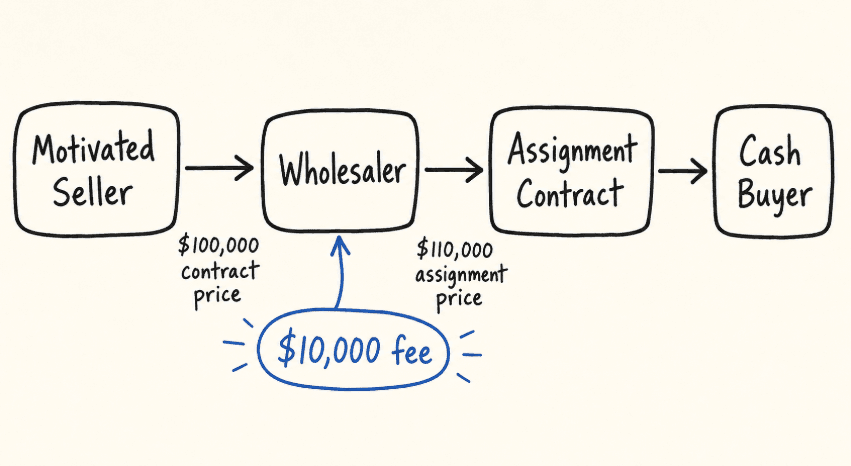
A wholesaler doesn't buy the house. They get the right to buy it. You find a motivated seller willing to accept below market, sign a purchase agreement, and then assign that contract to a cash buyer who closes the actual transaction. The seller gets the price they agreed to, the buyer gets the deal, and you collect an assignment fee without appearing on the deed.
Concrete example: a property is worth $200,000 after repairs. You get it under contract for $100,000, then assign that contract to a house flipper for $110,000. You keep $10,000. You never owned anything, and the whole transaction can close in a matter of weeks.
You're getting paid a $10,000 "finder's fee" just for finding the deal - and sometimes assignment fees can be much more than $10,000.
Finding motivated sellers
Motivated sellers aren't just people who want to sell fast. They're people whose circumstances make a below-market cash offer the right answer: an inherited property they can't manage from out of state, a preforeclosure, a divorce, a house needing $60,000 in repairs the owner can't fund.
Cold calling and SMS outreach are the lowest-barrier starting points. The only cost is time and a skip-tracing tool. Direct mail gets higher response rates but requires volume to work, and the upfront cost adds up fast. Most people starting out without capital begin with calls, then layer in mail once deals are generating revenue. Response rates on direct mail run between 0.5% and 2%, so the volume requirement is real.
Expired MLS listings and online marketplaces work better when paired with a consistent follow-up system. Most deals don't come from the first contact. No single channel dominates. Most active wholesalers run two or three simultaneously and nurture leads for 12 to 24 months.
Running the numbers
Every wholesale deal requires three numbers before you make an offer.
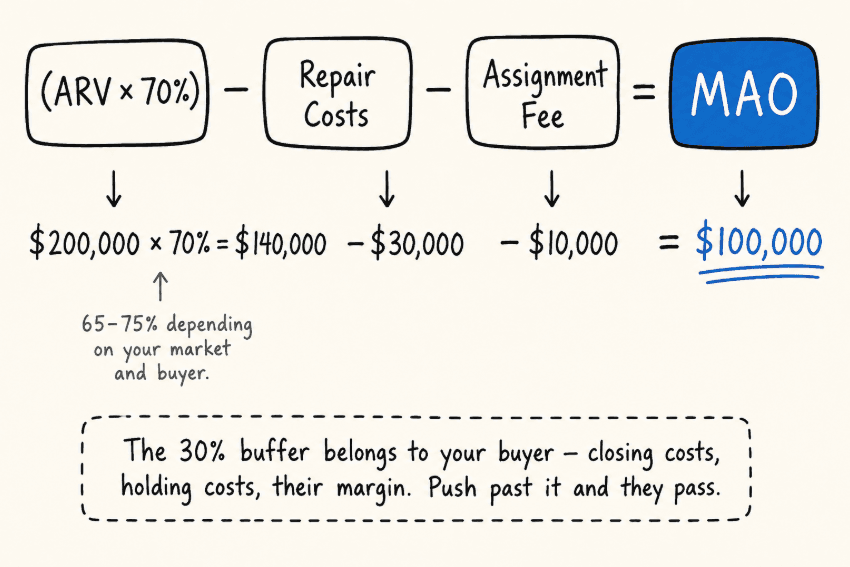
ARV is what the property would sell for fully renovated, based on comparable sales in the same neighborhood. Repair cost is a realistic estimate of what it takes to get there. MAO (maximum allowable offer) is the most you can pay and still leave margin for everyone in the deal.
The standard formula: (ARV x 70%) minus repair costs minus your assignment fee. Using the example above: $200,000 x 70% = $140,000, minus $30,000 in repairs, minus a $10,000 assignment fee = a $100,000 target offer. Get the property at or below that number, and you have a deal worth assigning.
The 70% figure isn't fixed. It protects the end buyer's profit on the flip, covering their closing costs, holding costs, and margin. Active investors in competitive markets sometimes push to 75-80%. In slower or riskier markets, buyers may require 65% or lower. ChatARV factors in local market conditions when calculating your MAO, so you're not applying a national average to a deal that needs a local number.
One more thing worth knowing: if the numbers shift after you're under contract, the inspection contingency is your exit. If the property condition is worse than represented, you can renegotiate or walk. Wholesalers who run accurate numbers upfront rarely need it, but it's there.
Pulling comps manually and running this in a spreadsheet takes 30 to 60 minutes per deal. ChatARV runs the comps, calculates ARV, estimates repairs based on condition, and outputs your MAO with the assignment fee already factored in. The comp report is shareable, so you can walk through it on a seller call instead of working from notes.
Assignment vs. double close
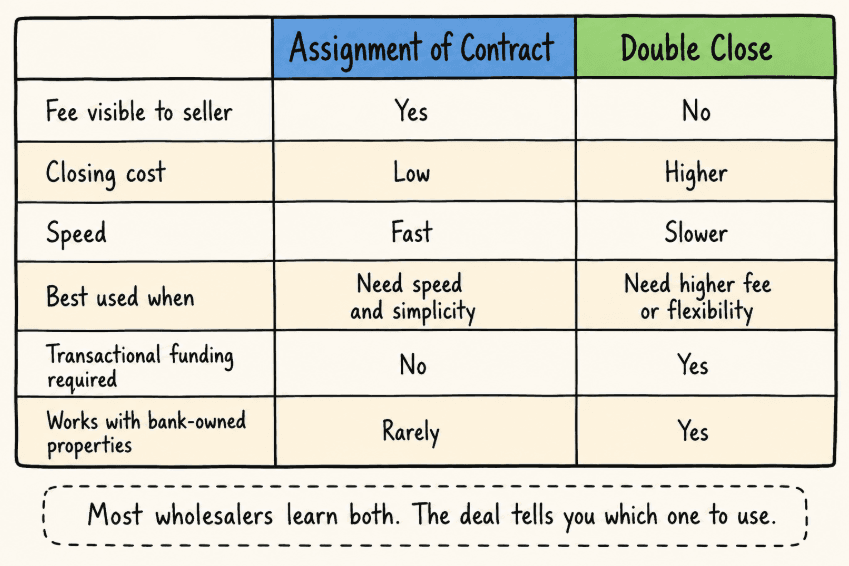
An assignment transfers your contract rights directly to the buyer. They pay the original purchase price plus your fee. Fast and straightforward, but your fee is visible to the seller — which some sellers push back on once they see the number. It also doesn't work if the original contract prohibits assignment, which is common with bank-owned or MLS properties.
A double close uses two separate transactions: you buy from the seller, then immediately resell to the end buyer. Your fee is embedded in the price difference and stays invisible. It adds cost — two closings, transactional funding for the first leg — but it solves the fee exposure problem and works around assignment restrictions.
Most wholesalers learn both and use whichever fits the deal.
What the numbers look like
Assignment fees on residential deals typically run $5,000 to $25,000, with the national average around $13,000. Most first deals land in the $5,000 to $10,000 range; that window keeps you competitive with buyers while still leaving enough margin for the deal to close. Chasing a $30,000 fee before you have a strong buyer list usually ends with an expired contract.
Deals close in two to four weeks from contract to assignment in most cases. That timeline compresses with a clean title and a ready buyer. It stretches when the title is cloudy, seller expectations are off, or the buyer list is thin.
Legal basics
Wholesaling is legal in all 50 states, but the regulatory picture changed significantly in 2025. Five states passed new laws, and a few of them drew hard lines.
Oklahoma (SB 1075, effective November 1, 2025): Wholesalers must provide written disclosures before any contract is signed, telling the homeowner you intend to assign the contract for a profit and advising them to seek legal counsel. Homeowners have a two-business-day right to cancel. Double closing no longer works as a workaround to avoid these requirements. You also cannot place any lien or cloud on the title to hold a deal together.
Tennessee (SB 909, effective April 8, 2025): Three specific disclosures required, all in bold, large font. You must tell the end buyer the nature of your equitable interest, that you don't own the property yet. You must tell the seller, before signing, that you intend to market or assign the contract. And you must give the seller at least three business days' notice before any assignment takes effect.
Maryland (HB 124/SB 160, effective October 1, 2025): Two written disclosures required, one to the seller before you sign, one to the buyer before you assign. You must disclose your intent to assign and that you may not be able to convey title. If either disclosure is missing, the seller or buyer can rescind the contract without penalty at any time before closing. No license required, but non-compliance voids your deal.
North Dakota (HB 1125, effective August 1, 2025): North Dakota has already required a real estate license to wholesale residential properties since 2023. HB 1125 extended those same requirements to commercial properties, so the license and disclosure rules now apply to all real estate transactions in the state.
Nebraska (LB892/2022 + LB187, effective July 1, 2025): Nebraska is the most restrictive market. Publicly marketing an equitable interest in a residential contract without a real estate license is illegal; it's classified as brokerage activity under state law. LB187, signed in March 2025, reinforced this and closed the remaining gray areas. The one exception is vacant land. If you're doing residential deals in Nebraska without a license, you're not in a gray area. You're breaking the law.
Connecticut (Public Act 25-168, effective July 1, 2026): Wholesalers will be required to register with the Department of Consumer Protection. Contracts must include a three-business-day seller cancellation window and cannot set a closing date more than 90 days out.
The regulatory trend is clear: more disclosure requirements, more license thresholds, more consumer cancellation rights. The line between wholesaling and brokerage has moved in the last three years and keeps moving. Regardless of state, tell sellers upfront that you're an investor, that you may assign the contract, and that you intend to profit from the transaction. Sellers who understand this going in don't feel blindsided when the assignment happens. Sellers who feel blindsided back out, file complaints, or spread the word in your market. A conversation with a local real estate attorney before your first deal is worth every dollar.