How to Find Off-Market Deals Before Anyone Else
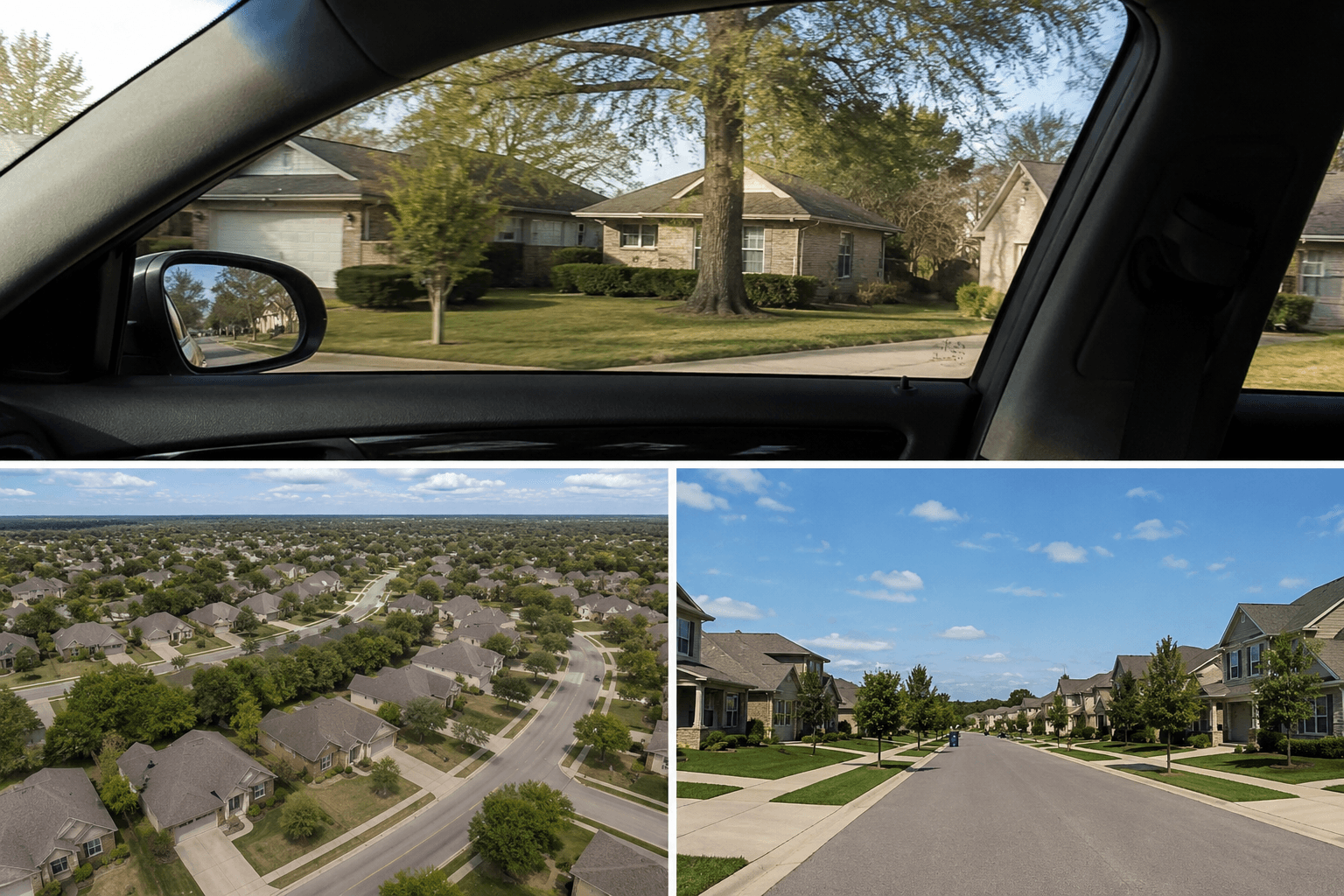
Driving for dollars is exactly what it sounds like. You get in your car, drive through neighborhoods you want to invest in, and look for distressed properties whose owners might be motivated to sell. You write down the addresses, find the owners, and reach out directly.
No auction. No MLS. No competing against twenty other investors who found the same Zillow listing. Just you, a route, and properties nobody else has on their list yet.
It's one of the oldest lead generation strategies in real estate investing, and in 2026, with paid list services increasingly saturated and the same data being sold to dozens of investors simultaneously, it's having a moment.
Why it still works
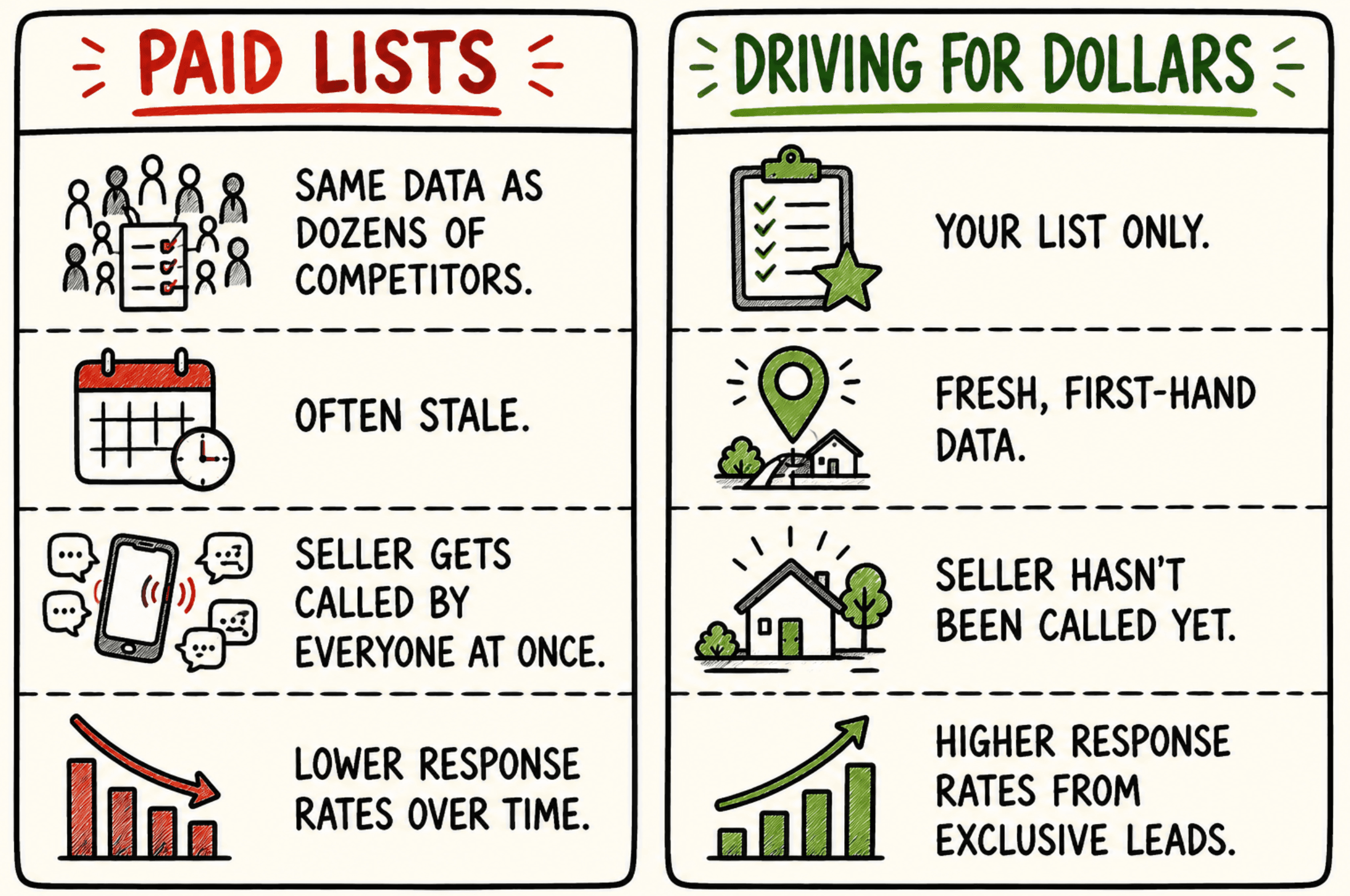
Most lead generation strategies rely on the same public data. When you buy a list of absentee owners or pre-foreclosures from a data provider, so do hundreds of other investors in your market. The same sellers get called, texted, and mailed by everyone at once. Response rates drop. Deals get competitive before you've even made contact.
Driving for dollars gives you fresh, first-hand data before it's scraped and sold to a dozen other investors. The list you build from driving is yours. Nobody else drove those exact streets on that exact day and added those exact properties. That's the competitive advantage: not the technology, not the data, just the fact that you showed up in person.
It also costs almost nothing. Your time, your gas, and your phone. For investors starting out without marketing budgets, it's often the first real lead generation tool that produces results.
What you're actually looking for
You're not looking for houses that need a coat of paint. You're looking for properties whose physical condition signals something about the owner's situation. Neglect on the outside usually means something is going on inside: financial pressure, an absentee owner who doesn't know what the property looks like, a landlord who's stopped managing it, or an estate no one has dealt with yet.
The signs that matter:
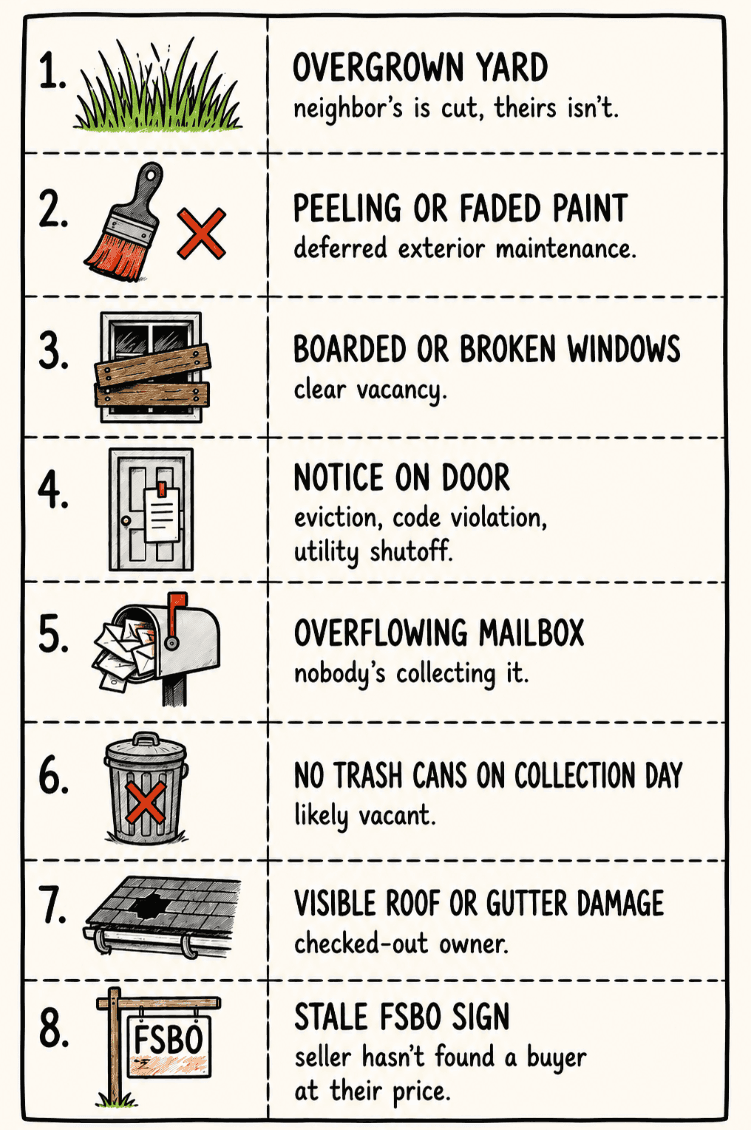
Overgrown lawn or vegetation. The most obvious signal. A yard that hasn't been cut in weeks or months in a neighborhood where everyone else is maintaining theirs means someone isn't paying attention to the property.
Peeling or faded paint. Deferred exterior maintenance on a property suggests the owner either can't afford upkeep or isn't prioritizing it. Either situation can mean motivation.
Boarded or broken windows. A clear vacancy indicator. Someone either left or was removed and the property hasn't been reoccupied.
Notices on the door. Eviction notices, code violation notices, utility shutoff notices: any posted document on a door is a direct signal of distress. These properties often have motivated sellers.
Overflowing mailbox or newspapers on the porch. Mail piling up means nobody is collecting it. That's vacancy or absenteeism.
No trash cans on collection day. In neighborhoods where everyone else has theirs out, a property with no cans is worth noting.
Sagging gutters, damaged roof visible from the street, rotting fascia boards. Deferred maintenance on systems that are expensive to fix suggests an owner who may have checked out.
FSBO signs that look old. A for-sale-by-owner sign that's been sun-bleached and sitting for months means the seller hasn't found a buyer at their price. That's a negotiation opportunity.
One thing worth knowing: the property doesn't have to be vacant to be a lead. A house with tenants who clearly aren't maintaining it, or a rental in visible disrepair surrounded by better-kept properties, often belongs to a tired landlord who's been meaning to sell for two years but hasn't gotten around to it. Those are some of the best conversations you can have.
How to actually do it
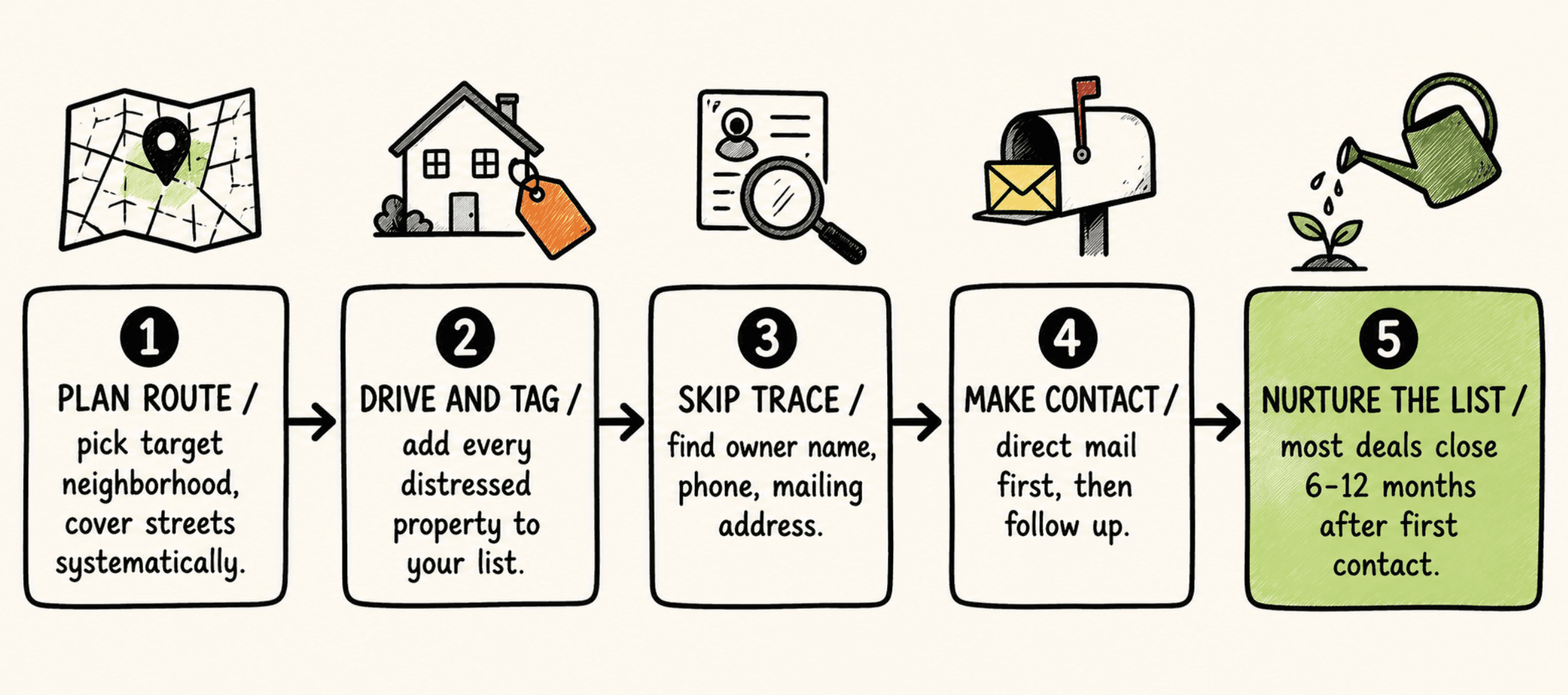
Plan your route before you drive. Pick a target neighborhood, one where you know cash buyers are active and the price range works for deals. Start with a specific area rather than driving aimlessly. You're looking to cover streets systematically, not wander.
Use an app. Driving for dollars apps, DealMachine is the most widely used, let you photograph a property, tag the address, pull owner information, and add it to your list without stopping the car. They also track your route so you don't cover the same streets twice. You can do all of this with notes on your phone too, but the apps make it significantly faster.
Tag everything that looks interesting. Don't pre-filter while you're driving. If it catches your eye, add it. You can triage the list later when you're not behind the wheel.
Aim for volume. A serious driving session adds 50-100 properties to your list. You're not evaluating whether these are deals yet, you're building a pipeline to work. Most of those properties will never become deals. That's fine. You only need one.
After the drive: finding the owner and making contact
An address without owner contact information is just an observation. The next step is skip tracing, using the property address to find the owner's name, phone number, and mailing address. Skip tracing services like BatchSkipTracing, Skip Genie, or built-in tools in apps like DealMachine typically cost $0.10-0.50 per record.
Once you have contact info, most investors send a direct mail piece first, a postcard or handwritten letter expressing interest in buying the property for cash, fast, with no hassle. Send it to the owner's mailing address from your skip trace, not the property address, which may be vacant or occupied by tenants who aren't the decision makers. Keep it short. You're not making an offer. You're opening a door.
Follow up more than once. Most deals don't come from the first contact. Investors who nurture their D4D lists for 6-12 months consistently outperform investors who mail once and move on. Timing matters: a seller who wasn't ready in January might be ready in August because something changed in their life.
What to do when an owner responds
This is the same conversation as any motivated seller call. Ask open-ended questions. Find out what's going on with the property and what a good outcome looks like for them. Don't lead with a number.
Once you understand their situation, you need three things before you can make an offer: ARV, repair costs, and your assignment fee. That tells you your MAO, the most you can pay and still have a deal worth assigning. ChatARV pulls the comps, calculates ARV from actual sold data, and outputs your MAO before you call the seller back, so the number you bring to the conversation is one you can back up. Run your numbers here.
Virtual driving for dollars
You don't have to be local to use this strategy. Virtual driving for dollars uses Google Street View to scout neighborhoods remotely, same visual checklist, same distress signals, just on a screen. It's slower and you can't see current condition the way you would in person, but it works for investors expanding into new markets before they've built a physical presence there.
The limitation: Street View images can be months or years old. The condition you see in the photo may not reflect reality in either direction, a property that looked distressed may have been renovated and sold, or a property that looked fine may have fallen into distress in the last year or two. Use it as a starting point and verify with recent satellite imagery or a local contact before you invest significant outreach effort.