$10,000 is enough to start in real estate. It is not enough to do everything. Most content on this topic either tells you you can build a portfolio with almost nothing, or tells you $10,000 is too small to matter. Both are wrong.
Here's what $10,000 actually gets you access to, and what it doesn't.
What $10,000 can't do
Let's start here, because being honest about limitations is more useful than pretending they don't exist.
$10,000 cannot fund a conventional rental property purchase. A $250,000 single-family rental at 15-20% down requires $37,500-$50,000 plus closing costs. You're well short.
$10,000 cannot fund a fix and flip through hard money. Hard money typically requires 10% or less down, so on a $200,000 purchase that's $20,000 before renovation costs, carrying costs, or origination points.
Saying this isn't discouraging. It's important context. $10,000 is a real starting point, but for certain strategies it requires substituting time and work for capital. That trade is worth understanding before you commit to a path.
What $10,000 can do
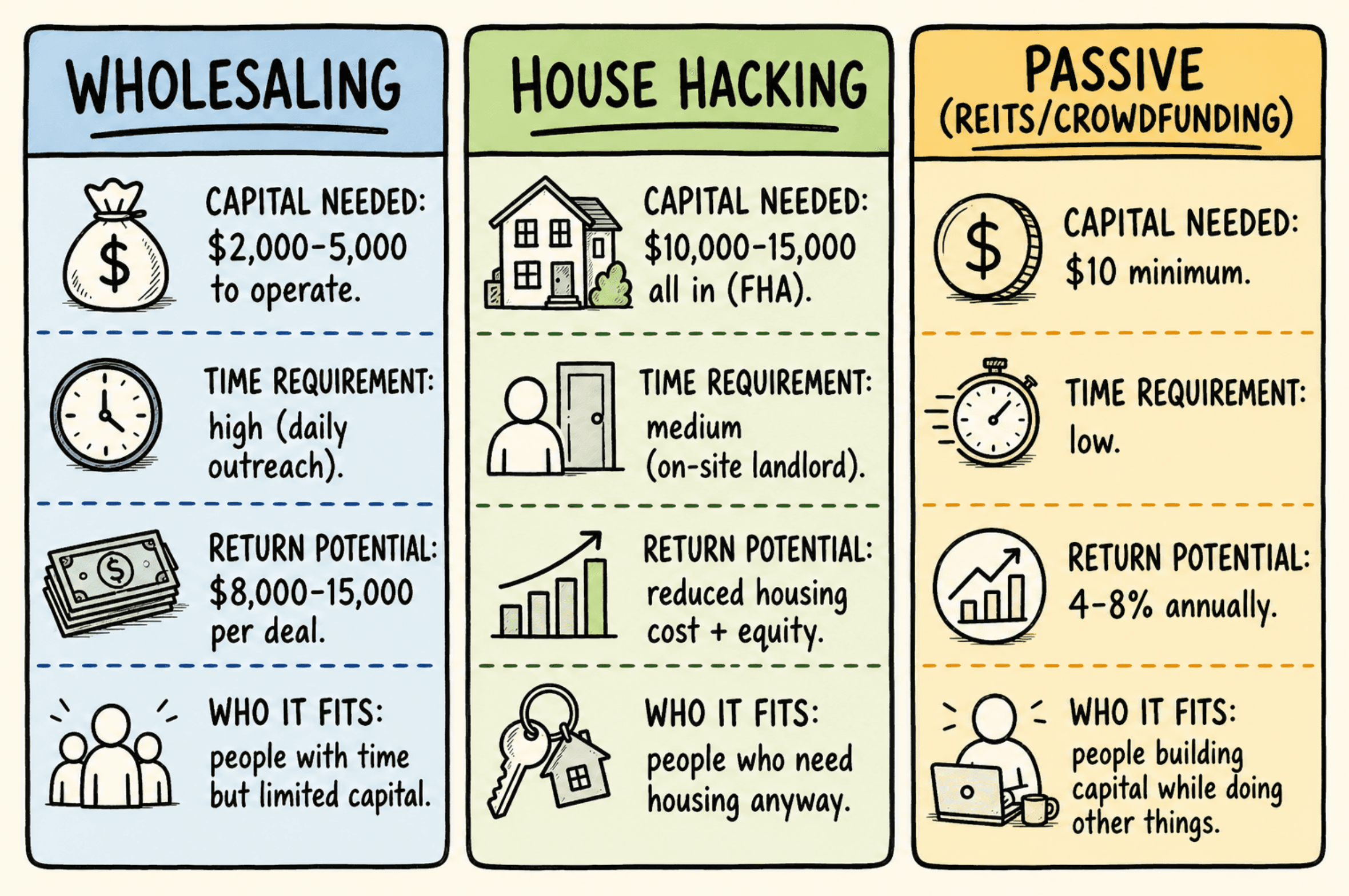
Wholesaling is the strategy that requires the least capital of anything involving actual real estate. You sign a purchase agreement with a motivated seller, assign the contract to a cash buyer before closing, and collect an assignment fee, typically $5,000-15,000, without ever buying the property.
You can start with almost nothing: a phone, gas money for driving for dollars, free tools from county recorder websites, and ChatARV for comps. Not every deal requires earnest money, but when one does expect it to be over $1,000 depending on the purchase price. The timeline from first marketing activity to first closed deal typically runs 60-120 days.
With $10,000 you're running a real operation: earnest money reserves across multiple deals at once, skip tracing costs, a basic CRM, an attorney-reviewed contract for your state, and enough marketing budget to sustain consistent outreach for several months. At that level you're not substituting time for money anymore. You're doing both.
The typical wholesaling metrics: 100 marketing touches generate 5-10 seller conversations, 5-10 conversations generate 1-2 contracts, 1-2 contracts generate 1 closed deal. One closed deal at a $10,000 assignment fee recoups your entire starting capital. Everything after that is profit being reinvested.
The work is real. Cold calling, driving for dollars, building a buyers list, running comps accurately, negotiating with sellers, managing the assignment process. None of it is passive. But the capital barrier is genuinely low.
House hacking, the most efficient use of $10,000 for someone without a home
If you don't own a home yet and plan to live somewhere anyway, house hacking is arguably the most powerful use of $10,000 in real estate in 2026.
FHA loans require just 3.5% down on owner-occupied properties up to four units. You get owner-occupant interest rates, around 6.2% versus 7-7.5% for investment loans, and your tenants' rent covers most or all of your mortgage.
On a $250,000 duplex, 3.5% down is $8,750. Add closing costs and you're usually at $12,000-15,000 all in, but you could keep it under $10,000 if you close the gap or negotiate seller concessions.
You live in one unit, rent the other. The rental income offsets your housing cost. You're building equity and learning how to be a landlord with the benefit of living on site. After one year of owner-occupancy you can move out and rent both units, or use the equity you've built to refinance into the next deal.
The catch: you need to actually live there for the FHA occupancy period, typically at least one year. And you need to find a property where the rental income from the other unit actually covers a meaningful portion of the mortgage, which requires market research and honest deal analysis.
Creative financing, buying a property with $10,000 down
Subject-to and seller financing both let you acquire a property with little to no traditional bank involvement.
With seller financing, the seller acts as the bank. You negotiate a down payment, interest rate, and monthly payment directly with them. $10,000 as a down payment on a $150,000-200,000 property is a realistic seller financing structure, especially with motivated sellers who want monthly income rather than a lump sum.
Subject-to works differently. You take over the seller's existing mortgage payments without the loan formally transferring to you. Your upfront cost is whatever the seller needs to walk away, which on a distressed deal can be a few thousand dollars. The rest of your $10,000 goes toward reserves and closing costs.
Both strategies require more negotiation skill than a standard purchase, and you need an experienced real estate attorney involved. But they open the door to actual property ownership at a capital level where traditional financing won't touch you.
Passive options, the lowest barrier, lowest return
For someone who wants real estate exposure without the active work, $10,000 opens the door to passive options:
REITs (Real Estate Investment Trusts) trade on public stock exchanges and let you own fractional interests in portfolios of commercial or residential properties. Minimum investment is the price of one share. Liquidity is high. Returns are lower than active investing and you have no control over the underlying assets.
Real estate crowdfunding platforms like Fundrise, RealtyMogul, or Arrived let you invest in individual properties or diversified funds with minimums as low as $10-500. You earn a portion of rental income and appreciation without managing anything. The tradeoff: your money is locked up for a defined period, returns are moderate, and you're trusting the platform's deal selection.
These are legitimate options for someone who wants market exposure while building up capital or knowledge for active investing. They're not a path to the same returns as owning and controlling real estate directly.
The honest timeline
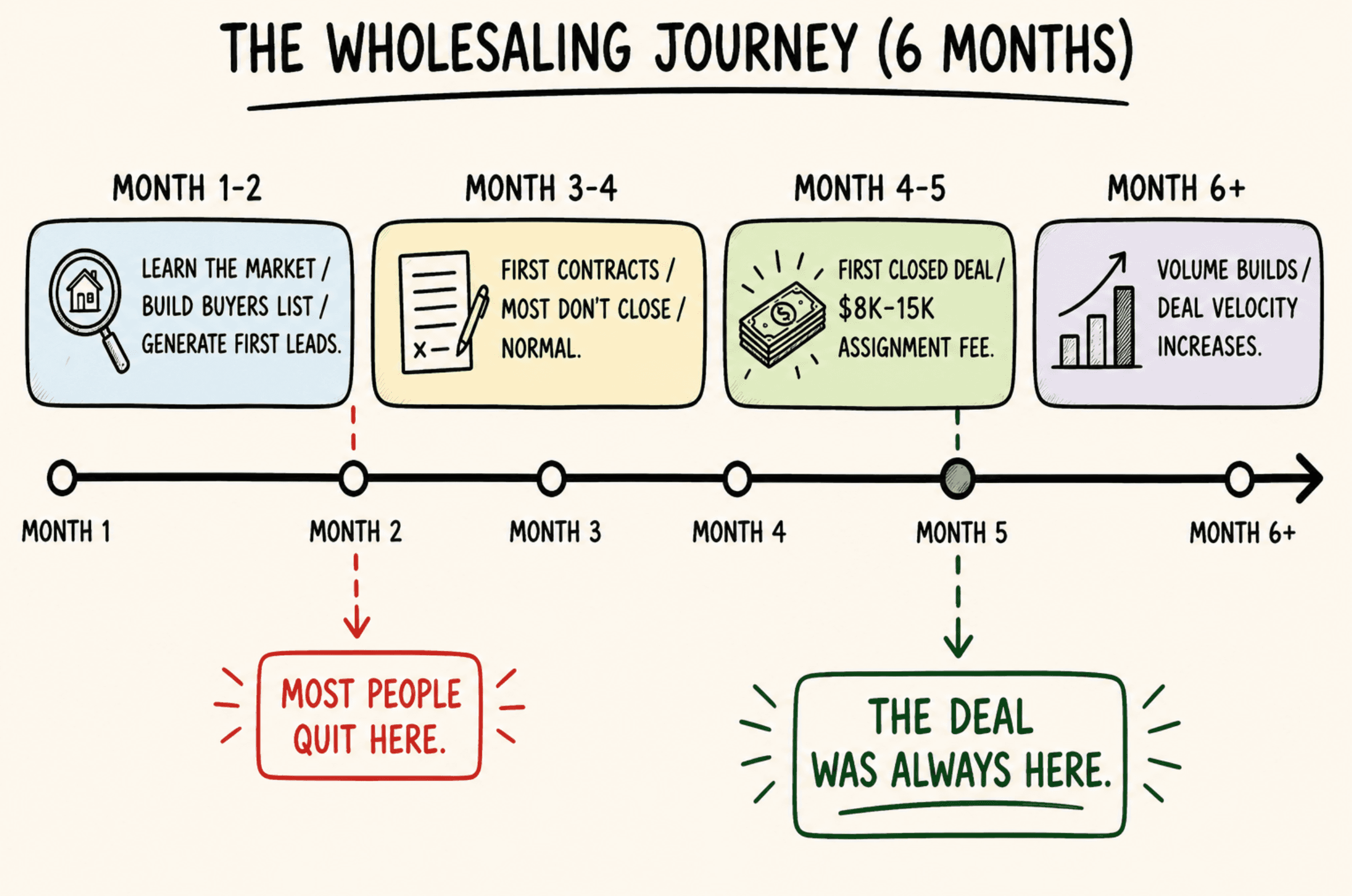
If you start wholesaling with $10,000 today and work consistently, making calls or driving for dollars every day, building your buyers list before you have a deal, running accurate deal analysis before you make offers, here's a realistic timeline:
Months 1-2: Learning your market, building your buyers list, generating leads. No deals yet.
Months 3-4: First contracts. Most don't close. Either the numbers don't work for buyers or the seller walks. This is normal.
Months 4-6: First closed deal. $8,000-15,000 assignment fee. Your starting capital is recovered or exceeded.
Months 6-12: With a track record and a real buyers list, deal velocity picks up. Volume investors doing 2-3 deals a month typically reach that in year one or two after consistent effort.
The people who quit in month two because they haven't closed anything yet represent the majority of people who start. The people who close their first deal typically do it around month four or five. The difference is almost entirely consistency, not luck.
The one thing that determines whether $10,000 turns into more
Whether your path is wholesaling, house hacking, or something else entirely, every real estate transaction depends on understanding what a property is worth and what it should cost. A wholesaler who overestimates ARV can't assign the contract. A house hacker who overpays has no margin. A BRRRR investor who gets the ARV wrong traps their capital.
$10,000 is a starting point. Accurate deal analysis is what makes it productive. ChatARV runs the deal: ARV from real comps, repair estimates, MAO for wholesale deals, and full buy-and-hold analysis for rentals, before you commit to any of it. Whether you're wholesaling, house hacking, or buying with seller financing, you need to know your numbers before you make an offer. Start a free trial here.
What most people get wrong about starting with limited capital
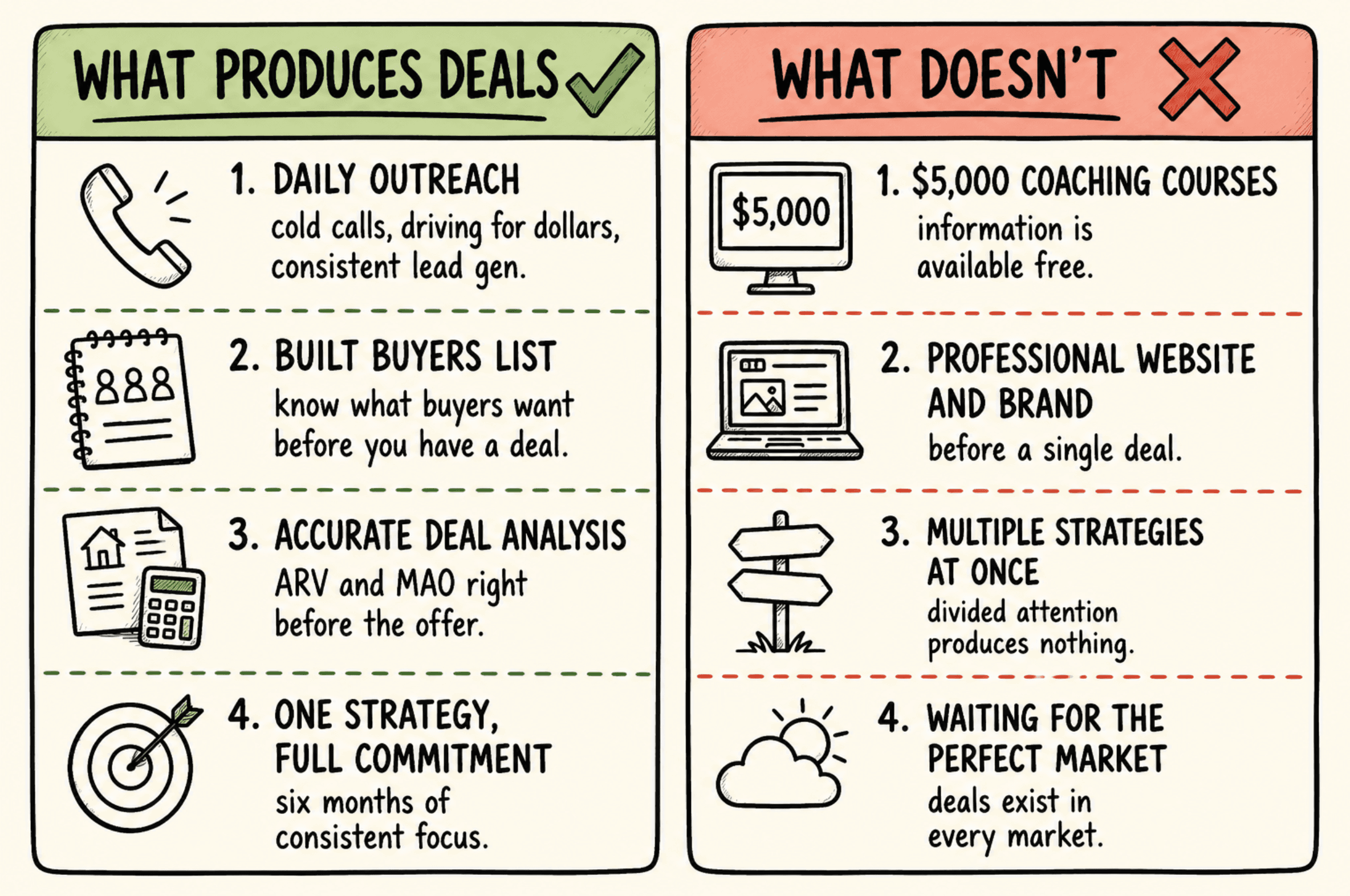
They spend money on the wrong things. A $5,000 coaching course, an expensive CRM before they have any leads, a professional website before they've done a single deal. None of that produces a deal. The information is available for free on YouTube, blogs, and at local REI meetups. A mentor you meet in person is worth more than a course. You work from your car, your kitchen table, or a coffee shop.
They wait for the perfect market or the perfect moment. There isn't one. Deals exist in every market because motivated sellers exist in every market. People inherit properties they don't want, go through divorces, face foreclosure, and have landlord burnout in every market in every year regardless of what's happening to interest rates or median home prices.
They chase multiple strategies simultaneously. Pick one, work it for six months, and get a deal done. The person who half-commits to wholesaling and also kind of tries house hacking and is also thinking about REITs doesn't get anywhere. The person who cold calls motivated sellers every morning for four months closes a deal.