Most new wholesalers think negotiation is about talking someone down to a lower number. It isn't. By the time you're negotiating with a motivated seller, the price isn't really the problem. Their situation is. Your job is to understand it well enough that your offer makes sense as the solution, not as an insult.
First: know what "motivated" actually means

A motivated seller isn't just someone who wants to sell fast. Plenty of people want to sell fast and still expect full market value. A motivated seller is someone whose circumstances have changed what the value means to them.
Inherited a house three states away they've never seen. Behind on payments and three months from foreclosure. Going through a divorce and both people just want out. Landlord who got one bad tenant too many and is done with the whole thing. The property needs $70,000 in work they don't have.
In every one of those situations, speed, certainty, and zero hassle are worth real money. That's what you're offering. Your job in the negotiation is to make that value clear, not to hammer them on price.
Talk before you offer
The biggest mistake new wholesalers make is leading with a number. You call, you low-ball, they hang up.
Before you ever mention price, you need to understand why they're selling. Not in a manipulative way, genuinely. Ask open-ended questions and then be quiet.
"What's going on with the property?"
"What would a good outcome look like for you?"
"How long have you been thinking about selling?"
On that first call, let them do 80% of the talking. Most sellers will tell you everything you need to know if you just stop talking long enough to let them. The reason they're selling tells you how to frame your offer. The landlord who's exhausted doesn't want to hear about your ARV. He wants to hear that you'll close in two weeks and he never has to deal with a tenant again.
The silence trick
Ask your question. Then stop talking.
This feels deeply uncomfortable the first few times. Your instinct will be to fill the pause. Don't. The seller who keeps talking past the silence is negotiating against themselves. They'll tell you their bottom line, their timeline, their biggest fear, all of it, if you just wait.
One of the most powerful negotiation tactics is also the simplest: let the seller negotiate with themselves before you ever make an offer.
How to deliver a low offer without losing the conversation
Your number is going to be low. They know it's going to be low. Pretending otherwise helps nobody.
The way you survive this moment is by explaining the math before you give the number. Walk them through it. "The property needs about $40,000 in work to get to where comparable homes are selling. A cash buyer is going to pay me based on what it's worth after repairs, minus what it costs to fix, minus their profit. That's where my number comes from."
When the number is attached to a logical chain they can follow, it's harder to argue with. When you just say "$95,000" and wait, all they hear is an insult.
Know your MAO before you pick up the phone. A common mistake new wholesalers make is listening to the seller's ask first and then developing a bias toward that number when they go run comps. ChatARV calculates your MAO from actual comps before you ever speak to the seller — so when you explain the number, you can back it up with no anchoring bias from the seller's ask.
The objections you will definitely hear
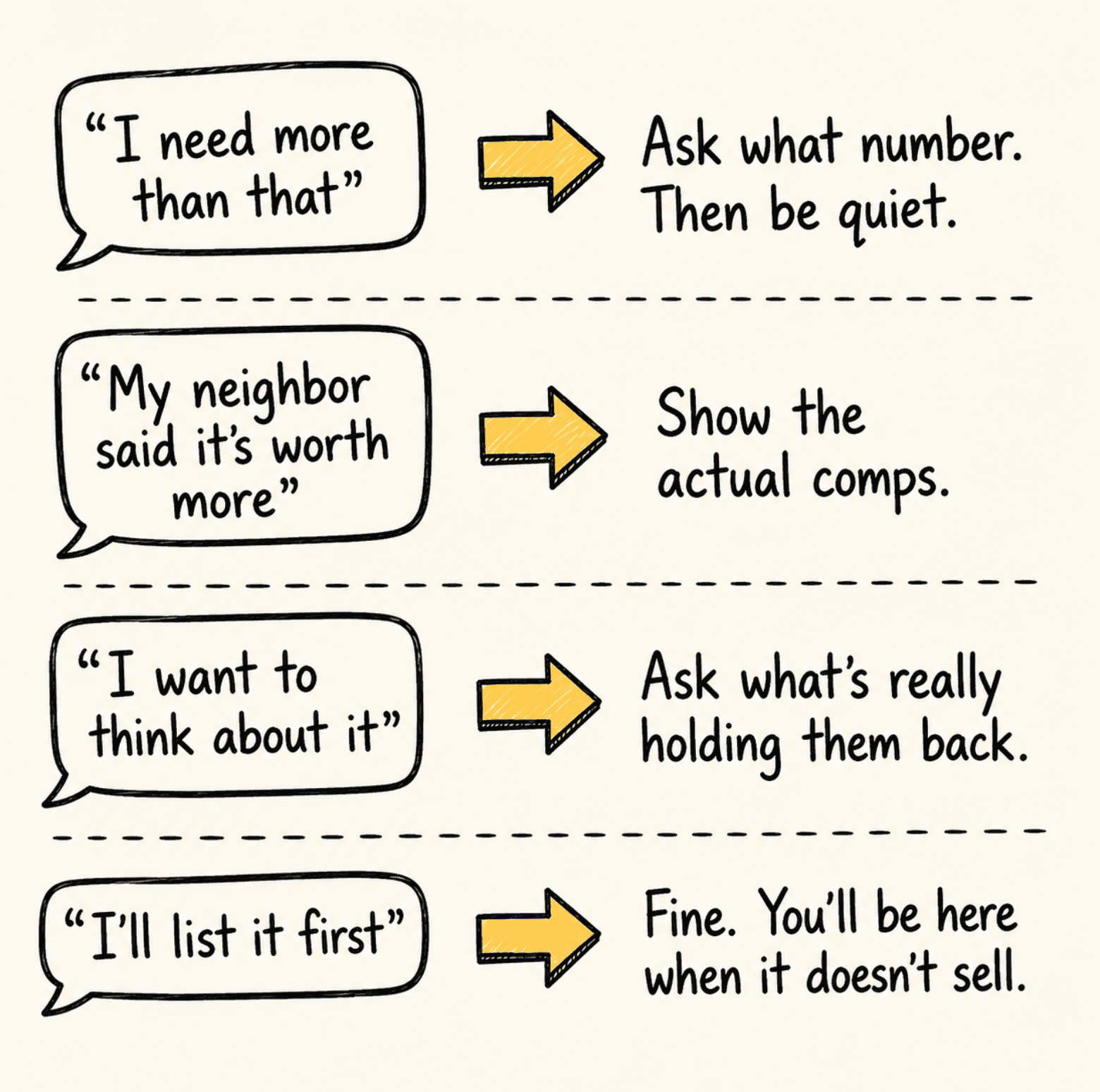
Don't panic and don't immediately move. Ask: "What number were you hoping for?" Then be quiet again. If their number is workable, great. If it isn't, explain why, calmly and specifically. "At that price the deal doesn't work. Is there any flexibility on timeline or terms that might help?"
Sometimes the gap isn't money. It's closing date, staying in the property for two extra weeks, not having to clean it out. Those things cost you nothing and can close a deal.
"My neighbor said it was worth more."
The neighbor didn't walk through it. The neighbor doesn't know what the roof looks like. This is where having real comps matters. You're not arguing with the seller, you're showing them what actually sold nearby, in what condition, and for how much. That conversation is very different when you have a report in front of you versus asking them to just trust your number.
"I want to think about it."
Usually means "I'm not ready to say no to your face." Dig in gently. "Totally fair, what's the main thing holding you back?" More often than not they'll tell you the actual concern and you can address it directly.
"I'm going to list it with an agent first."
If they're truly motivated, they usually won't follow through. Listing means 3-6 months of showings, uncertainty, and a closing that can fall apart at inspection. Name that directly.
"That makes sense if time isn't a factor. Most listings in this area take 60-90 days to close, and that's if the first buyer doesn't back out. If you need a guaranteed close on a specific date, that's harder to get on the open market. I'm here if the timeline matters."
If they still want to list, let them go. Someone willing to wait six months for full market value isn't the motivated seller you're looking for. Follow up every few weeks. They may call back when it doesn't sell.
"Your fee is too high."
If they find out your assignment fee and push back, you have two options. Explain it matter-of-factly; you're getting paid for finding the deal and bringing a buyer who can close. Or, if the deal has enough margin, absorb some of it. What you never do is panic, apologize, or dramatically cut the number to save the conversation. That tells them you were padding from the start.
Sometimes you need to walk away
If you've mentally committed before the numbers even work, you will lose leverage. Approach every negotiation willing to walk away if the numbers don't align.
This isn't a tactic. It's just true. A deal that doesn't work at your MAO doesn't work. Chasing a bad number to avoid losing the conversation is how wholesalers lose money.
The sellers who sense you need the deal more than they do will use it. The ones who believe you'll walk if it doesn't pencil will negotiate seriously.
Follow up without being annoying
Most deals don't close on the first call. The seller isn't ready. The timing is wrong. They want to try the agent first.
None of that means no forever. A quick "just checking in, still here if you need a fast close" every few weeks keeps you in the game without being the person they dread picking up for. Most active wholesalers are nurturing leads for 12-24 months. The deal that closes in month eight often started as a flat no in month one.