How to Make Offers on Wholesale Deals
Making an offer is easy. Making the right offer is hard, and it's one of the biggest things new wholesalers get wrong.
Many new wholesalers find a deal they like, get emotionally attached, stretch their number to make it work, and end up with a contract no cash buyer will touch. But with good math, we can make sure that never happens.
The three numbers you need before you make any offer
Every wholesale offer comes down to three inputs:
ARV: what the property will be worth after it's fully renovated, based on what comparable renovated homes nearby have actually sold for.
Repair costs are a realistic estimate of what it costs to get the property renovated to the same standard as the comps.
Your assignment fee is what you need to make on the deal to make it worth doing.
Everything else is arithmetic.
The MAO formula
MAO stands for Maximum Allowable Offer. It's the most you can pay and still have a deal worth assigning.
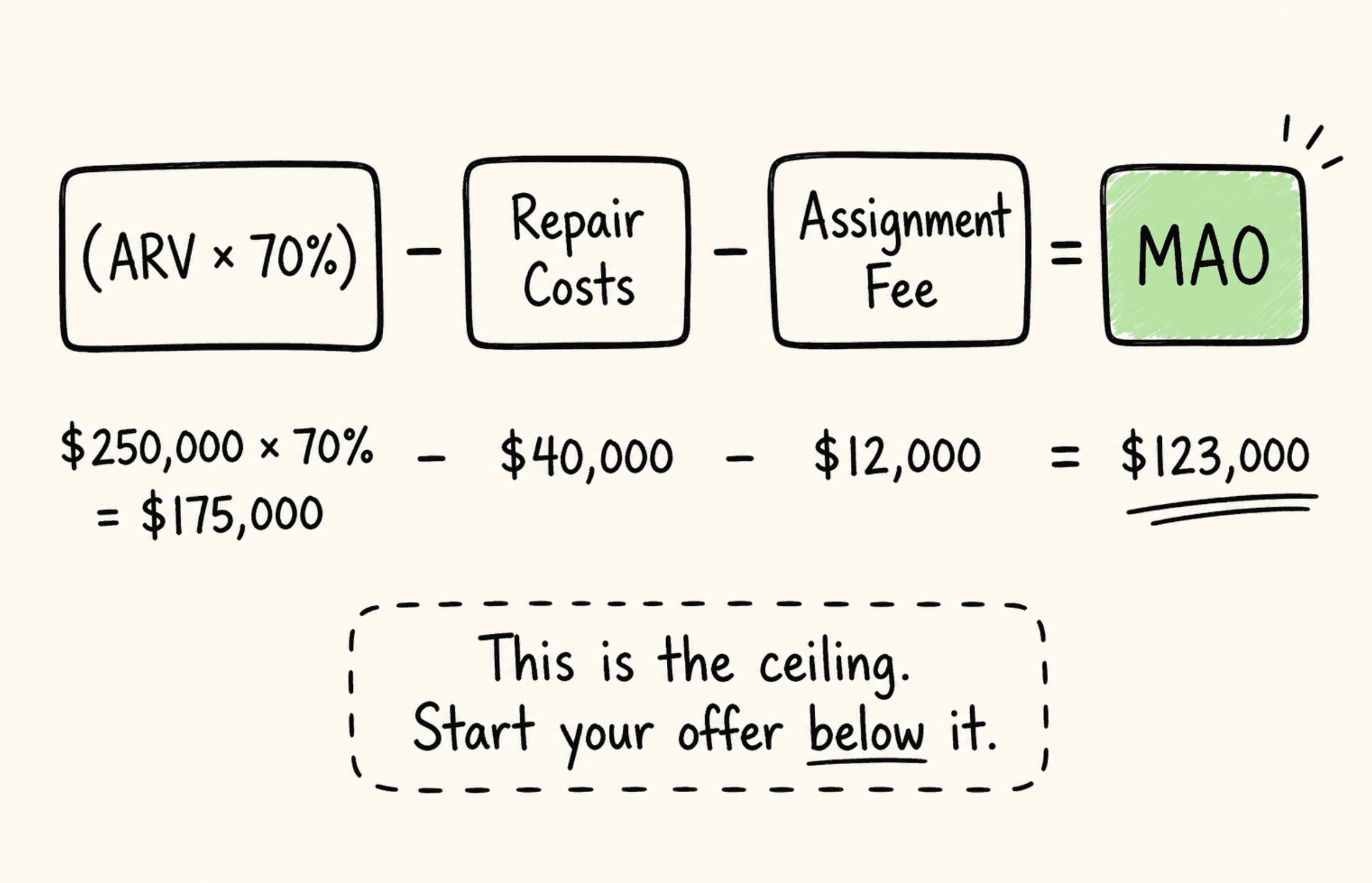
(ARV × 70%) – Repair Costs – Assignment Fee = MAO
A concrete example. ARV is $250,000. Repairs are $40,000. You want a $12,000 assignment fee.
$250,000 × 70% = $175,000
$175,000 – $40,000 = $135,000
$135,000 – $12,000 = $123,000 MAO
That's the ceiling. Your offer should be at or below that number. If the seller won't go there, the deal doesn't work — and no amount of wanting it to work changes that.
The 70% isn't random. It leaves room for the end buyer's profit, their closing costs, holding costs, and the unexpected things that always come up in a rehab. It's what makes the deal worth buying for the person on the other end of your assignment. Without it, your contract sits unsold.
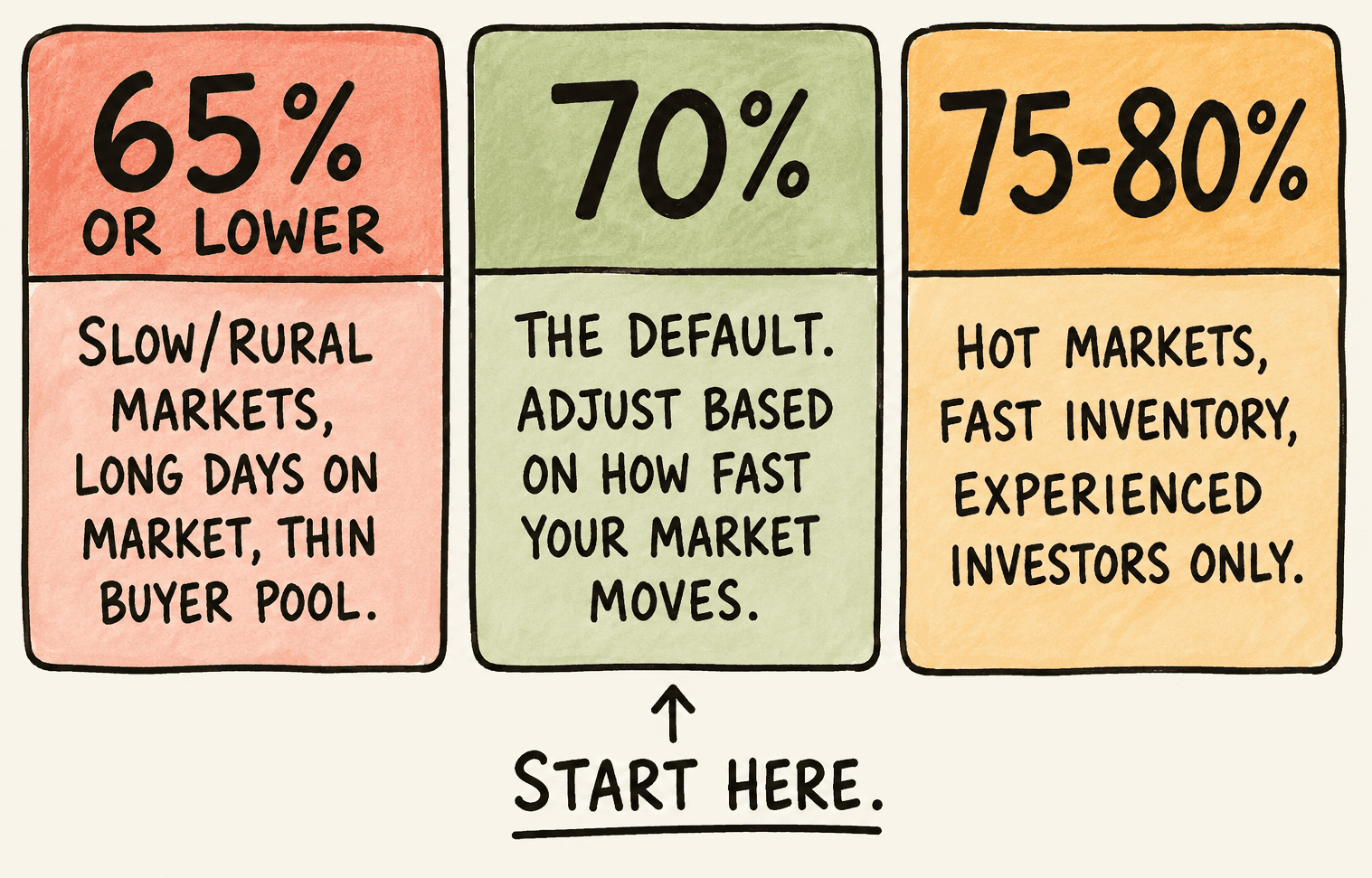
The 70% is a starting point, not a law. In practice:
In slow or rural markets where days on market are long, and buyers are thinner, some investors drop to 65% or lower. The longer a property sits, the more it costs the end buyer, and they price that in.
In competitive markets with fast-moving inventory and strong buyer demand, experienced investors sometimes move to 75%. A few go to 80% on cosmetic-only deals in hot zip codes, but you'll need to be careful when going this high.
The honest answer is: ask your buyers what they need before you set your percentage. Your MAO is only as good as your ability to assign the contract. If your buyers need 70% to make it work, then 72% is not a deal; it's a problem you're going to discover in three weeks when nobody bites. ChatARV calculates the right percentage for your market based on how fast inventory is moving, so you're not guessing.
Where the formula breaks down
The math is simple. The inputs are where people get hurt.
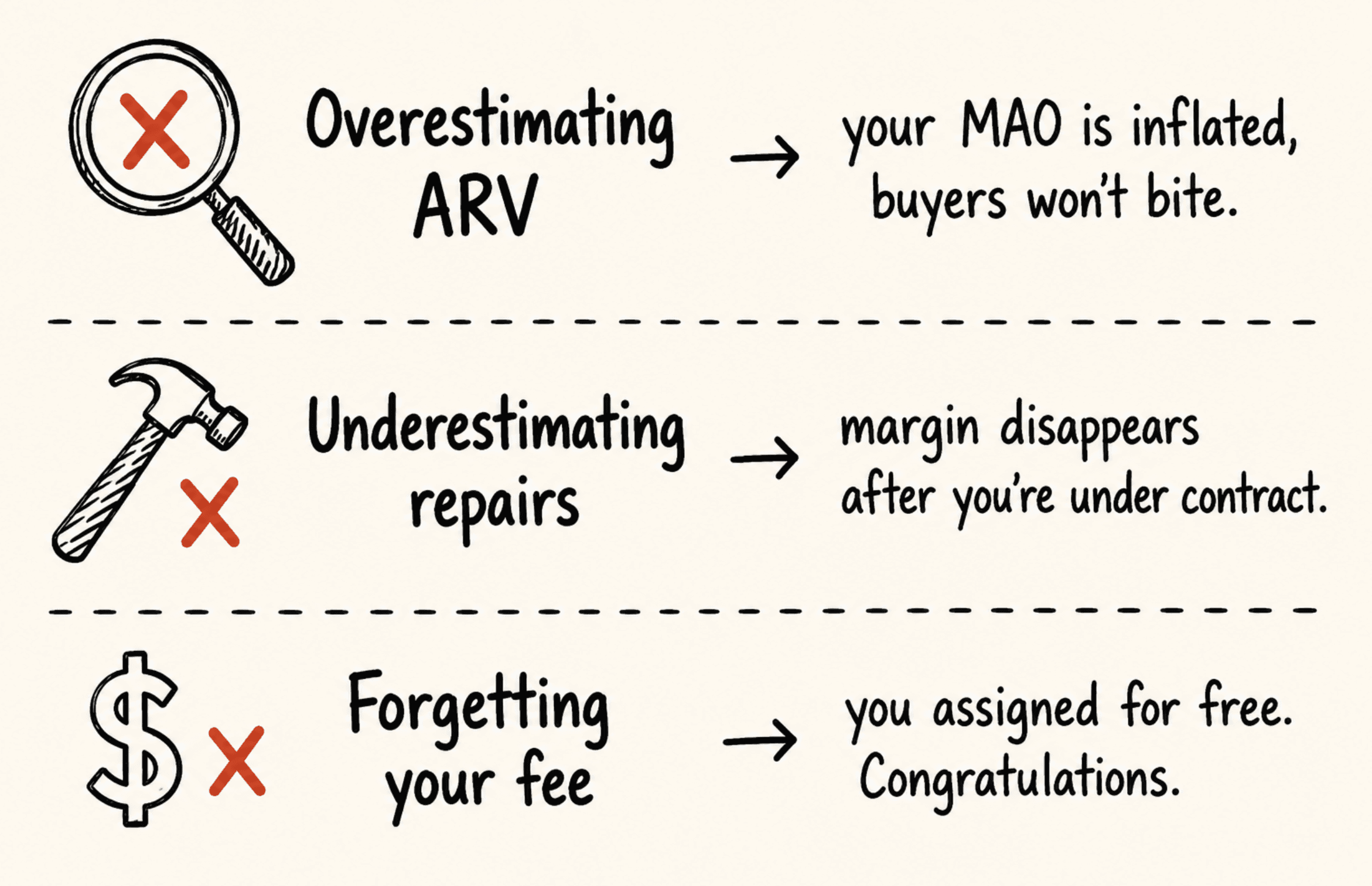
Overestimating ARV. This is the most common and most expensive mistake. It usually happens when investors use comps that are too far away, too old, or from a different part of the neighborhood. A comp from six months ago in a cooling market is not your ARV today. A comp from three streets over in a better school district is not your ARV. ChatARV uses measures like school rankings, average $/sqft of sales, and other information to determine how valuable an area is and find the right comps.
Underestimating repairs. New investors almost always do this. They walk through a house, see it needs paint and flooring, and write $15,000. Then the inspector finds knob-and-tube wiring, a cracked foundation, and an HVAC system from 1987. Suddenly it's $55,000. Always add a contingency buffer of 10-15% on top of your estimate. The inspector almost always finds something the walkthrough missed.
Start below your MAO
Your MAO is the ceiling, not the opening bid.
If your MAO is $123,000, start at $105,000 or $110,000. Give yourself room to move. Sellers almost always push back, and if your first offer is already your maximum, you have nowhere to go. You either hold a number that feels arbitrary, or you break your own math to save the conversation.
Starting below your MAO also protects you from the version of yourself that wants the deal too much. The number you calculate before you talk to the seller is the honest one. The number you invent during the conversation to keep the seller from hanging up is how you end up with a bad contract.
What to do when the seller is above your MAO
This happens on almost every call. Here's how to handle it without folding.
Explain the math, not just the number. "The property needs about $40,000 in work. Based on what similar renovated homes have sold for nearby, $123,000 is the most I can pay and make the deal work. At $150,000 the numbers don't work for me, and I'd have to walk away."
Ask if terms are flexible rather than just price. A seller who won't move on price might be fine with a longer closing date, leaving personal property behind, or other concessions that cost them nothing but help you.
If there's genuinely no path to a number that works, walk away cleanly. "If your situation changes or the listing doesn't move, I'm here." A lot of those sellers call back. Not all of them, but enough that burning the relationship over a number that doesn't work is always the wrong move.
Run the numbers before you need them
The single biggest advantage you can have on a seller call is knowing your offer before the conversation starts. But when the seller counters or new information changes the deal, you need to adjust on the spot. ChatARV's wholesale calculator pulls real comps, calculates your ARV from actual sold data, and outputs your MAO with your assignment fee already factored in, whether you're prepping before the call or recalculating mid-conversation. Start your free trial here.