
Every wholesale deal, fix and flip, and BRRRR strategy starts with the same thing: a property the owner is motivated to sell below market value. Finding those properties is where most of the real work in real estate investing happens, and where most beginners spend too little time building a real system.
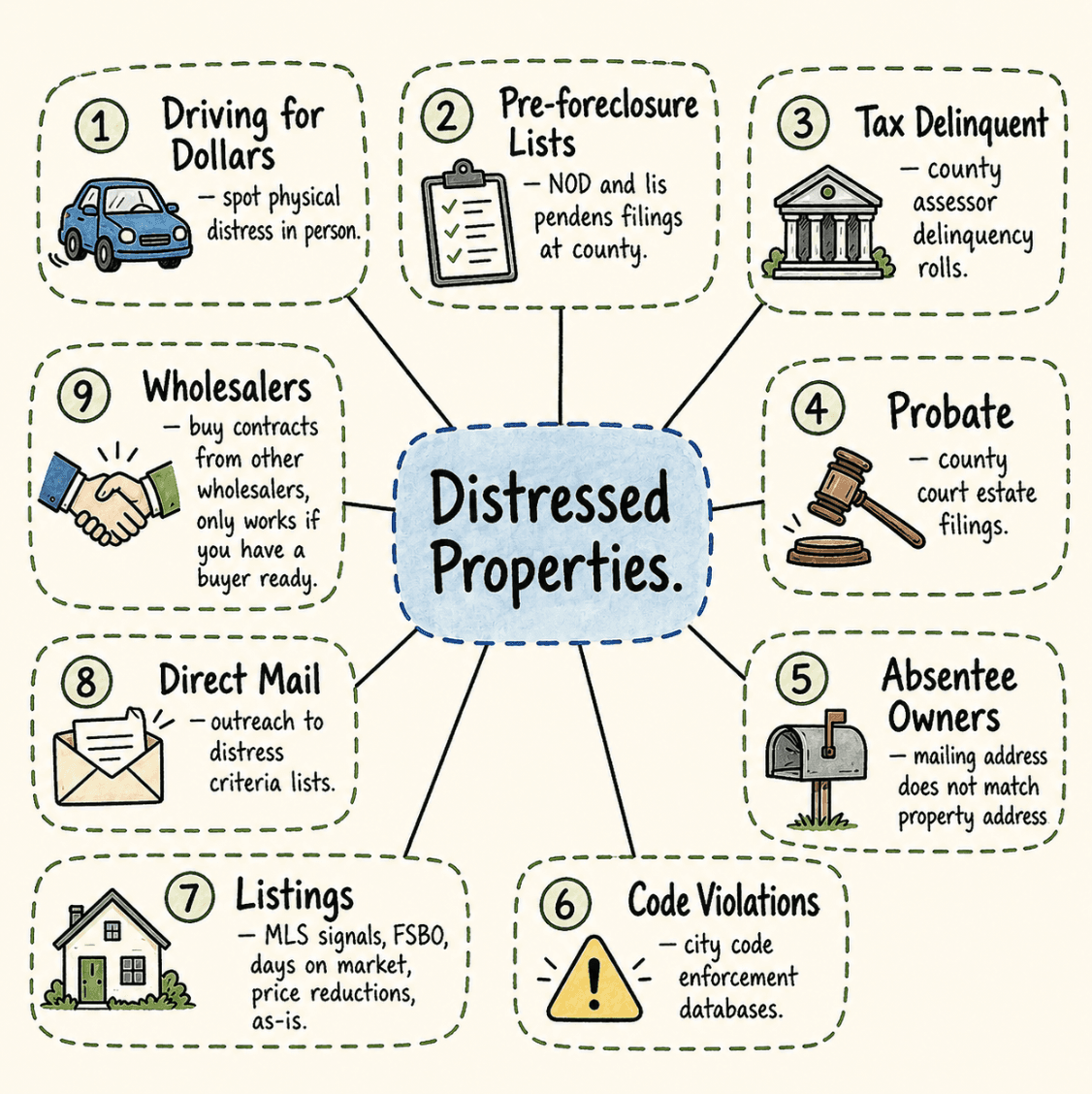
Here's every meaningful source of distressed properties, how each one works, and what it actually takes to generate consistent deal flow from each.
What makes a property distressed
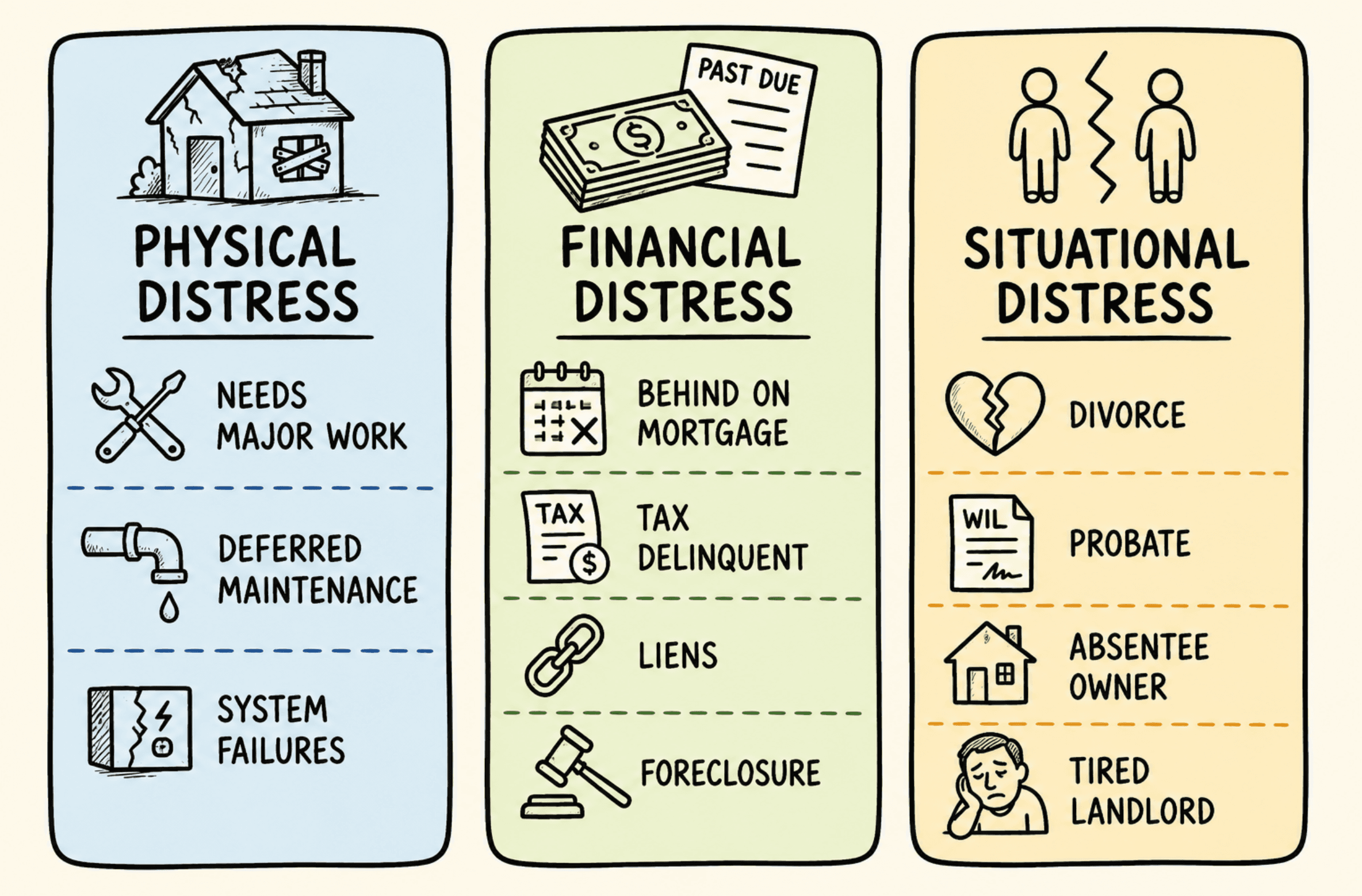
Distressed doesn't always mean the house is falling apart. It means the owner's circumstances have created motivation to sell, often at a steep discount, that the open market wouldn't otherwise produce.
Physical distress: the property needs significant work. Deferred maintenance, major system failures, structural problems, years of neglect. The owner can't afford to fix it or doesn't want to.
Financial distress: the owner is behind on mortgage payments, owes back taxes, has liens on the title, or faces foreclosure. Selling at a discount beats losing everything to the bank or the county.
Situational distress: divorce, probate, out-of-state ownership of an inherited property, a tired landlord who's done dealing with tenants, a job loss, a health crisis. The situation creates urgency that the market value alone wouldn't.
Distressed properties offer 20-40% discounts that fuel BRRRR, flip, and wholesale strategies. The discount compensates for real risk: hidden damage, title complications, longer timelines. Most sellers are dealing with more than one type of distress at once. The financial pressure creates the deadline, and the physical or situational context is what keeps retail buyers out of the picture. That combination is what makes the deal work.
Source 1: Driving for dollars
The oldest method and still one of the most effective for generating leads nobody else has. You drive neighborhoods, spot physical distress signals: overgrown lawn, peeling paint, boarded windows, notices on the door, accumulated mail. Note the address. Skip trace the owner, reach out directly.
The competitive advantage is the list you build from driving belongs only to you. Nobody else drove those streets that day. The data isn't being sold to 50 other investors simultaneously.
Covered in depth in our driving for dollars guide. The short version: drive systematically with a route, use an app to tag properties and pull owner info in real time, aim for 50-100 addresses per session, and follow up consistently over months.
Source 2: Pre-foreclosure lists
When a homeowner falls behind on mortgage payments, the lender files a public notice: a Notice of Default (NOD) in non-judicial states or a Lis Pendens in judicial states. That filing is a public record, and it's your earliest signal that a motivated seller exists.
Foreclosure filings increased 14% in 2025, reaching over 367,000 properties, the first significant uptick since 2019. That means a larger pool of pre-foreclosure leads than investors have seen in several years.
How to access these: most counties publish NOD and lis pendens filings through the county recorder or clerk website. Search for the filing portal, set up a regular pull of new filings, and reach out immediately. The window between filing and auction ranges from 90 days to 2+ years depending on the state, but the sellers who receive the fewest calls are the ones who just filed.
Covered in depth in our pre-foreclosure investing guide.
Source 3: Tax delinquent properties
When a property owner stops paying property taxes, the county records it publicly. According to Cotality's 2025 Property Tax Delinquency Report, the national tax delinquency rate reached 5.1% in 2025, up from 4.5% in 2024, and property taxes have risen 27% since 2019, putting real pressure on owners who are already stretched thin. An owner who isn't paying taxes is either financially distressed, an absentee owner who doesn't know what's happening with the property, or the heir of a deceased owner who hasn't taken control of the estate.
All three situations produce motivated sellers.
How to find them: your county tax assessor or treasurer website typically publishes delinquency rolls, lists of properties with unpaid taxes. Many counties now make these available as downloadable files. Search your county name plus "delinquent tax list" or "tax sale properties." Pull the list, skip trace the owners for contact information, and reach out before the property goes to auction.
The best opportunities are properties where the owner is a few years delinquent but hasn't yet reached auction, they have time to sell and a clear financial incentive to do so.
Source 4: Probate properties
When someone dies, their property typically passes through probate, a court-supervised process of transferring assets to heirs. Heirs who inherit a property often have no interest in keeping it, especially if it needs work, is out of state, or comes with tax or maintenance obligations.
These are some of the most motivated sellers in any market. They didn't ask for the property. They don't want to manage it. They want it gone.
How to find probate properties: county probate courts file records publicly. Search your county name plus "probate court filings" or "estate proceedings." You're looking for recently opened estates with real property listed among the assets. The executor or administrator of the estate has legal authority to sell. They're your point of contact.
One important note: many platforms market "probate leads" that are actually just deceased-owner flags that don't have real court filings or case numbers. Look for platforms that source actual probate court filings, not just death records matched to property ownership. ProbateData covers all 50 states with daily-updated probate filings and integrated property data.
Goliath Data takes a similar approach, pulling leads directly from public court filings and surfacing executor contact information, useful if you want leads fed into a CRM without manually reviewing county records. USLeadList is a lower-cost option if you're just getting started. All three source actual court filings rather than death record proxies.
Source 5: Absentee owner lists
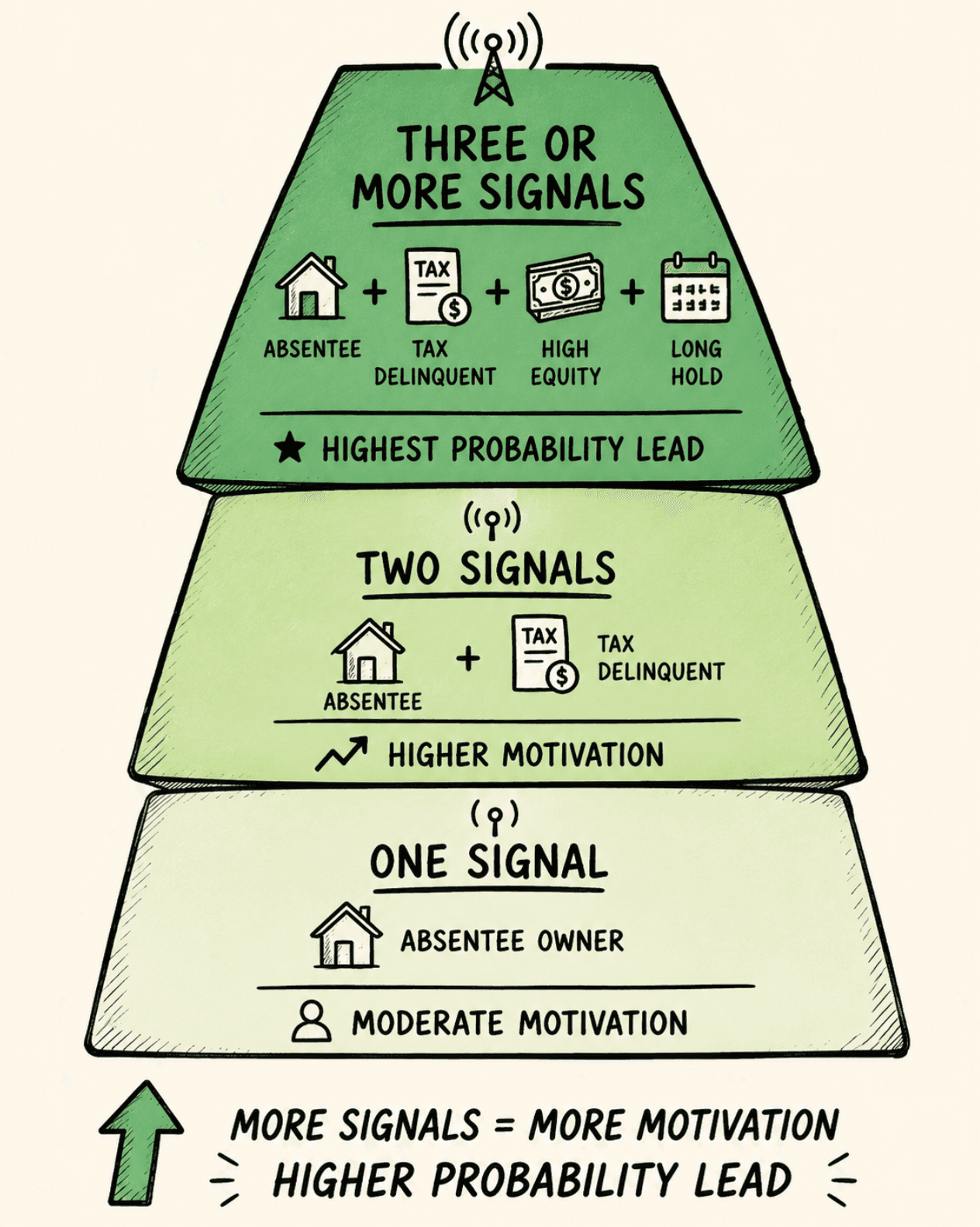
An absentee owner is someone whose mailing address doesn't match the property address, meaning they don't live in the property. Landlords, out-of-state heirs, investors who bought and moved on, people who relocated for work. When combined with other distress signals like long hold period, high equity, and years of rental history, absentee owners produce some of the highest response rates of any lead source.
How to find them: county assessor records show both the property address and the owner's mailing address. Any property where these differ is an absentee owner. Most data platforms (PropStream, BatchLeads, DealMachine) let you filter for absentee owners directly. You can also pull this manually from county records for free, just more slowly.
The power of absentee lists multiplies when stacked with other signals: an absentee owner who is also tax delinquent with high equity and a long hold period is a significantly higher probability lead than any of those signals alone.
Source 6: Code violations and condemned properties
Municipal code enforcement offices publish records of properties that have received violations for maintenance failures, safety hazards, or habitability issues. These are properties the city has already flagged as problematic, meaning the physical distress is documented rather than assumed.
How to find them: search your city or county name plus "code violations public records" or "code enforcement database." Many municipalities publish searchable violation databases online. Others require a public records request. Properties with multiple violations or a history of recurring issues represent the most motivated sellers.
Source 7: MLS listings
The MLS is where most wholesalers go wrong. Getting a property under contract at $10k below asking and trying to sell it at asking isn't wholesaling. It's just a slow sale that won't close. The MLS works as a distressed property source when you're reading the right signals, not just chasing price gaps.
The signals that matter: days on market (60, 90, 120+ days sitting), price reductions, descriptions that say "as-is," "estate sale," "seller motivated," or "bring all offers." Expired listings are worth targeting: the seller wanted to sell and couldn't, and reaching out after expiration often finds them at their most receptive.
The limitation is real: MLS properties have been exposed to the full market, so the discount is usually smaller than what you'd find off-market. Before you contract anything on the MLS, run the numbers in ChatARV to confirm you're buying at a price that actually works for an investor exit, not just below what the seller was asking.
Source 8: Direct mail
Send letters or postcards directly to owners of properties that fit your distress criteria: absentee owners, pre-foreclosures, high-equity long-hold properties, tax delinquent owners. The message is simple: you're a local investor who buys properties for cash, fast, in any condition, without agent fees.
Direct mail generates higher response rates than cold calling on the same lists because you're reaching people when they're in their home, in a contemplative state, rather than interrupting their day. The drawback is cost: designing, printing, and mailing takes money. And volume. Response rates typically run 0.5-2%, meaning you need to send hundreds of pieces before you have substantive conversations.
The investors who succeed with direct mail do it consistently over months, not as a one-time campaign. Most deals come from the third or fourth touch with the same seller, not the first.
Source 9: Wholesalers and investor networks
If you're a flipper or BRRRR investor, other wholesalers are your best deal source. They've already done the lead generation work, gotten the property under contract, and are looking for a buyer to assign it to. Building relationships with active wholesalers in your market by attending REIAs, joining local investor Facebook groups, and responding quickly when deals come through gives you a consistent flow of vetted off-market deals.
The tradeoff: the wholesaler's fee comes out of your margin. The property has already been found and contracted, so the discount relative to what a wholesaler might have gotten directly from the seller is smaller. For investors who want deal flow without running a full acquisition operation, this tradeoff often makes sense.
What to do when you find one
Finding the property is step one. Before you make an offer on anything distressed, you need three numbers: ARV, repair costs, and MAO. A distressed property with a great story and bad numbers is not a deal. It's a contract you can't assign or a flip that loses money.
ChatARV pulls comparable sales, calculates ARV from actual sold data, estimates repair costs by condition, and outputs your MAO before you call the seller. For non-disclosure states where comp data is limited, ChatARV applies proprietary methods to improve accuracy across all 50 states. Run your numbers here.
Building a system instead of chasing leads
The investors who find deals consistently aren't lucky. They have a system: two or three lead sources running simultaneously, a regular schedule for pulling new data, a follow-up sequence for every lead, and the patience to nurture relationships for months before a deal materializes. Most wholesale deals don't come from the first contact. Investors who nurture leads for 6-12 months consistently outperform investors who contact once and move on.
Pick two sources. Work them every week. Follow up on every response. Analyze every deal quickly. The pipeline builds from consistency, not from any single clever lead source.