
Most people researching this question are actually asking something simpler: which one can I start with? The honest answer is that wholesaling and flipping aren't really competitors; for most active investors, wholesaling comes first. It's how you learn the market, build deal sourcing channels, and generate the capital that eventually funds your first flip. Understanding how they're different helps you figure out where you actually are right now.
What each strategy actually is
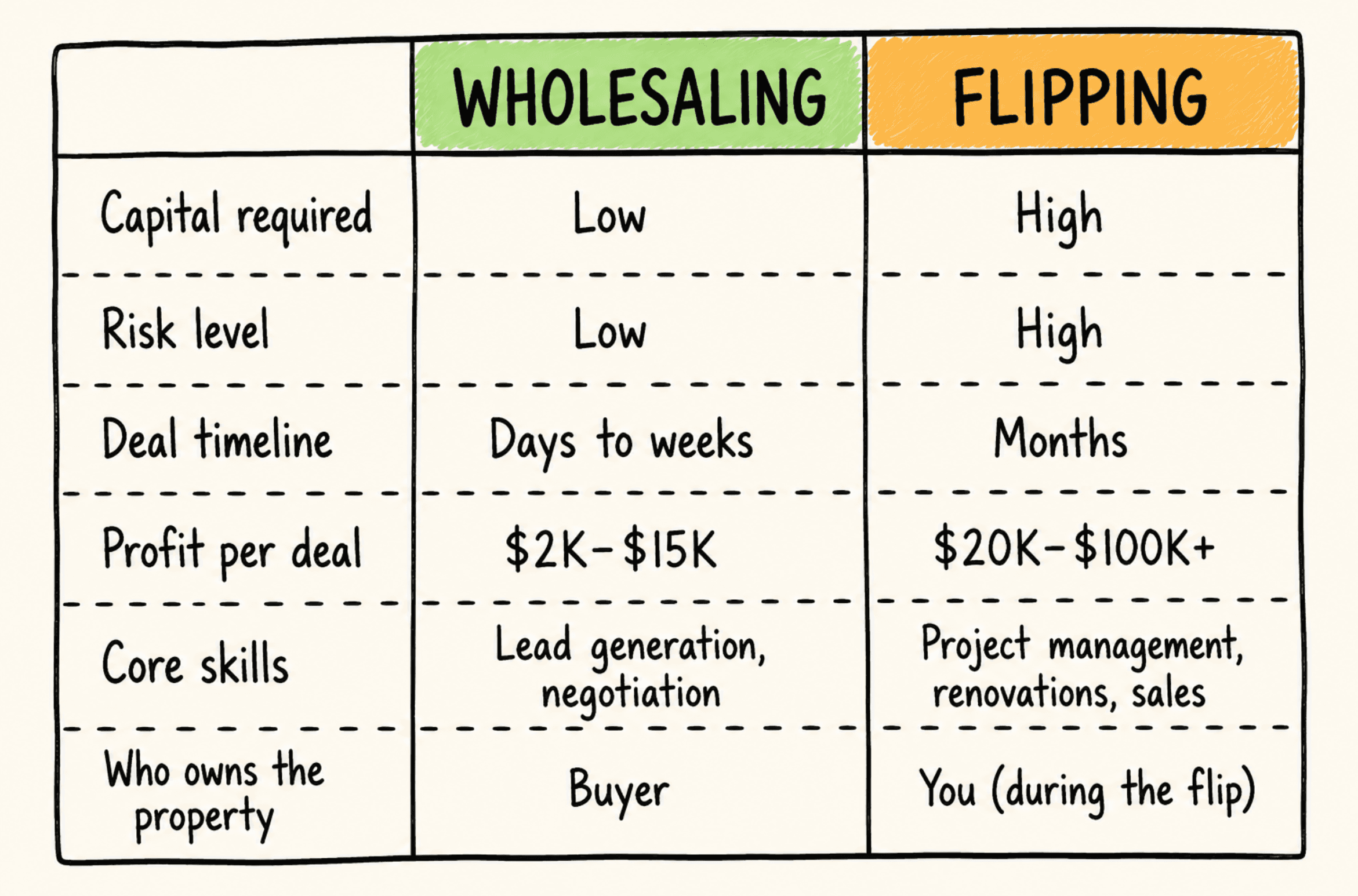
Wholesaling means getting a distressed property under contract below market value and selling that contract to a cash buyer before closing. You never own the property. Your profit is the spread between your contract price and what the buyer pays you for it, typically $10,000 to $25,000 per deal. It's a marketing business.
Flipping means buying the property, renovating it, and selling it on the open market. You own it, you fund the rehab, you carry it until it sells. Your profit is the difference between what you paid plus renovation costs and what it sells for. The average gross profit in 2025 was $65,981, according to ATTOM, though that's before holding costs, financing, and taxes. The whole cycle runs four to six months minimum.
Same source material, distressed properties bought below market. Very different execution, capital requirements, and risk.
The real differences
Capital. Wholesaling requires almost none. You'll need a bit of money to start to buy software and buy leads or run marketing - maybe $1,000 to $2,000. You may occasionally need earnest money to get under contract, usually $500 to $2,000, and a buyers list to assign it to. Flipping requires enough to buy the property, fund the entire renovation, and carry the asset for months. That's typically $50,000 to $200,000 depending on the market, either from your own pocket or a hard money loan you're paying 10-13% interest on while the clock runs.
Risk. In wholesaling, your downside is losing your earnest money if the deal falls apart and you can't assign it — and the time you spent on a deal that didn't close. In flipping, your downside is a renovation that runs over, a market that softens while you're holding, an ARV you overestimated, or a property that sits unsold for months eating carrying costs. Flip ROI in 2025 hit 25.5%, its lowest point since 2007, down from 32.1% the prior year. Margins are compressed and the deals that work today require precise underwriting. Beginner mistakes are expensive.
Time. Wholesaling is volume-based. Experienced wholesalers run multiple deals simultaneously, each closing in weeks. Flipping is project-based. Most fix and flip projects run four to six months from acquisition through closing on resale, with investors advised to model five to six months minimum to account for permitting delays, contractor scheduling, and resale time on market. One bad contractor can eat your entire margin.
Skills. Wholesaling rewards lead generation, negotiation, and the ability to move fast. Flipping rewards project management, contractor relationships, accurate scoping, and market timing. They overlap at one point: deal analysis. Both strategies live or die on whether you got the ARV right and the repair cost right before you committed.
The math is the same. The stakes are different.
Here's the thing most comparison articles miss: the core formula is identical for both strategies.
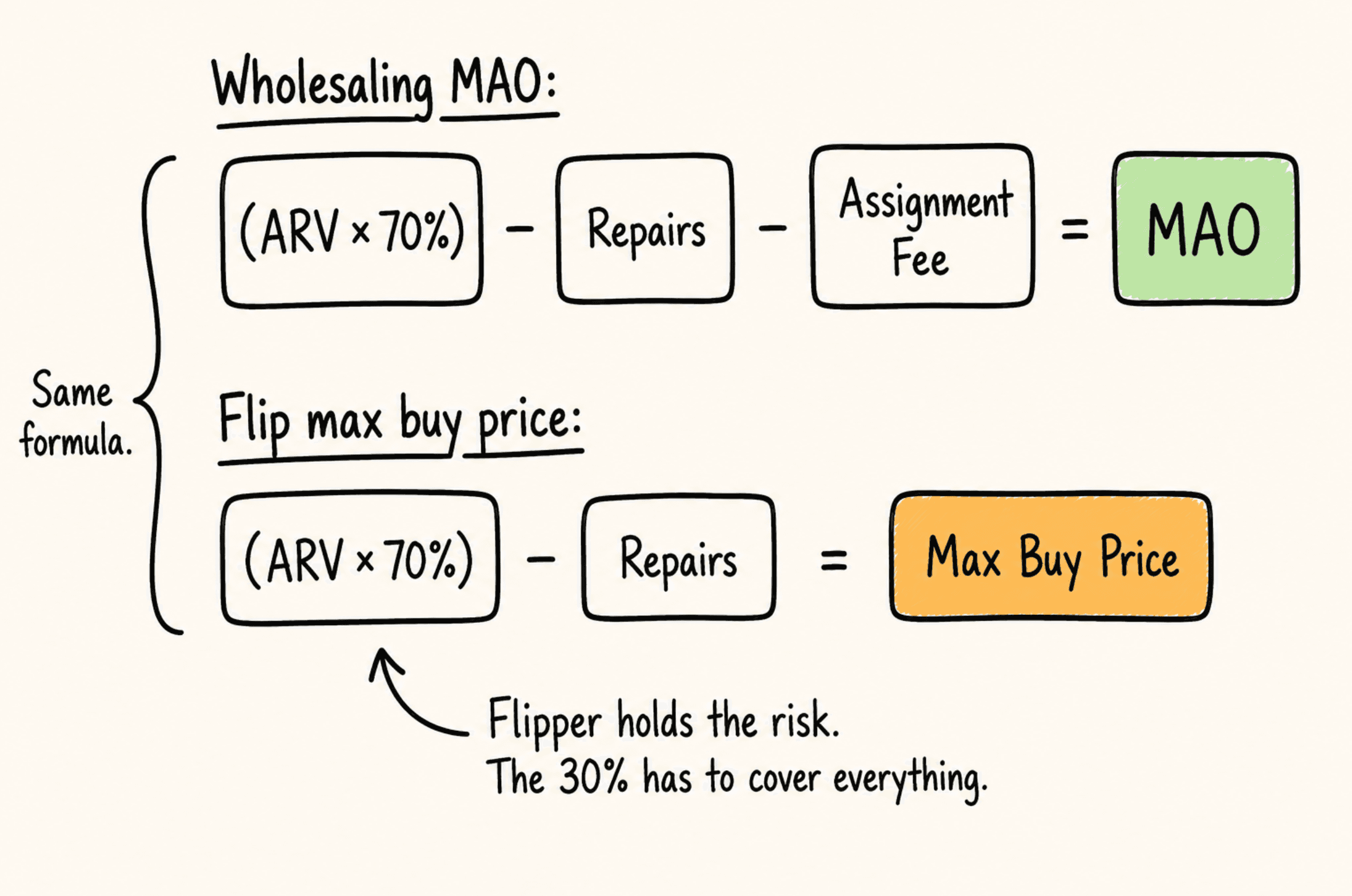
For wholesaling, your MAO is: (ARV × 70%) − Repairs − Your Assignment Fee
For flipping, your maximum buy price is: (ARV × 70%) − Repairs
Same calculation. The difference is what happens after. The wholesaler assigns the contract and collects the fee. The flipper buys, renovates, holds, and sells, and the 30% buffer has to cover all of that plus their profit.
This means a deal that works as a wholesale might not work as a flip, and vice versa. A property with a $200,000 ARV and $20,000 in repairs has a wholesaler MAO of around $110,000 at a $10,000 fee. A flipper buying it at $120,000 might still make the numbers work. A flipper buying it at $150,000 probably doesn't, even though the property is technically below ARV.
Getting the ARV and repair costs right before you commit matters in both strategies; it's just more catastrophic in flipping because you're actually holding the asset. ChatARV's free wholesale calculator runs both the MAO for a wholesale deal and the full flip analysis, ARV from actual comps, repair cost estimates, and deal underwriting, before you make an offer.
Most investors do both, sometimes at the same time
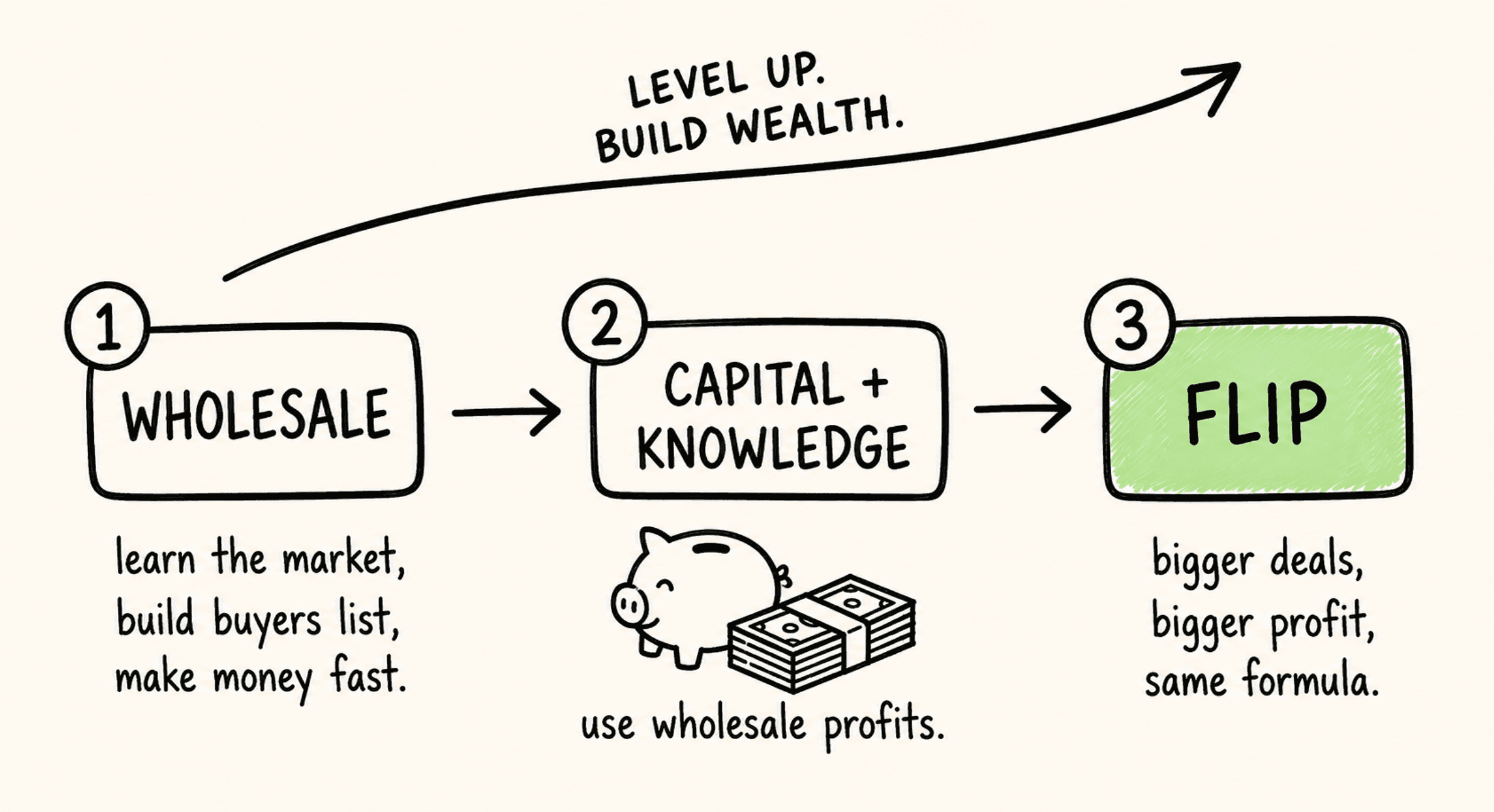
The path most active investors actually take looks like this: start wholesaling, learn the market without risking capital, and use that deal flow to identify properties worth keeping. The best ones get flipped. The rest get assigned.
This is how wholesaling and flipping naturally converge. You're already sourcing deals, running comps, and talking to motivated sellers. When a deal comes through with enough margin to flip, you buy it instead of assigning it. When the margin is thinner, or the project is too complex, you wholesale it and take the fee. The same lead channel feeds both strategies.
Your first flip isn't a guess at that point, it's a deal you understand because you've already seen dozens like it from the wholesale side. You know the neighborhood, you know what cash buyers pay, and you know what renovated comps look like because you've been running them.
Off-market sourcing through probate, pre-foreclosure, and direct mail is outperforming MLS deals for investors who need margin. The best flippers have wholesaler relationships or are wholesalers themselves.
Which one is right for you right now
Wholesaling makes more sense if you're starting without significant capital, want faster feedback loops, or are still learning your market. The downside is capped, you lose earnest money and time, not a six-figure renovation budget.
Flipping makes more sense if you have access to capital or financing, have contractor relationships you trust, have already done enough deals to know your market's ARV behavior, and want larger per-deal profits.
The question isn't which strategy is better. It's which one matches where you actually are, not where you want to be in two years.