
You need buyers lined up before you sign your first contract, not after. Here's how to actually build that list.
A buyers list isn't contacts, it's proof of purchase
A cash buyers list is a database of active investors, flippers, landlords, BRRRR buyers, who close without financing contingencies. Without one, a signed contract has nowhere to go. What matters isn't the contact count, it's knowing each buyer's criteria well enough to know before you lock up a deal whether they'd want it. A name on a list isn't a cash buyer. A track record is. Someone who's actually wired funds and taken a deed in the last year beats a hundred people who filled out a "we buy houses" form once.
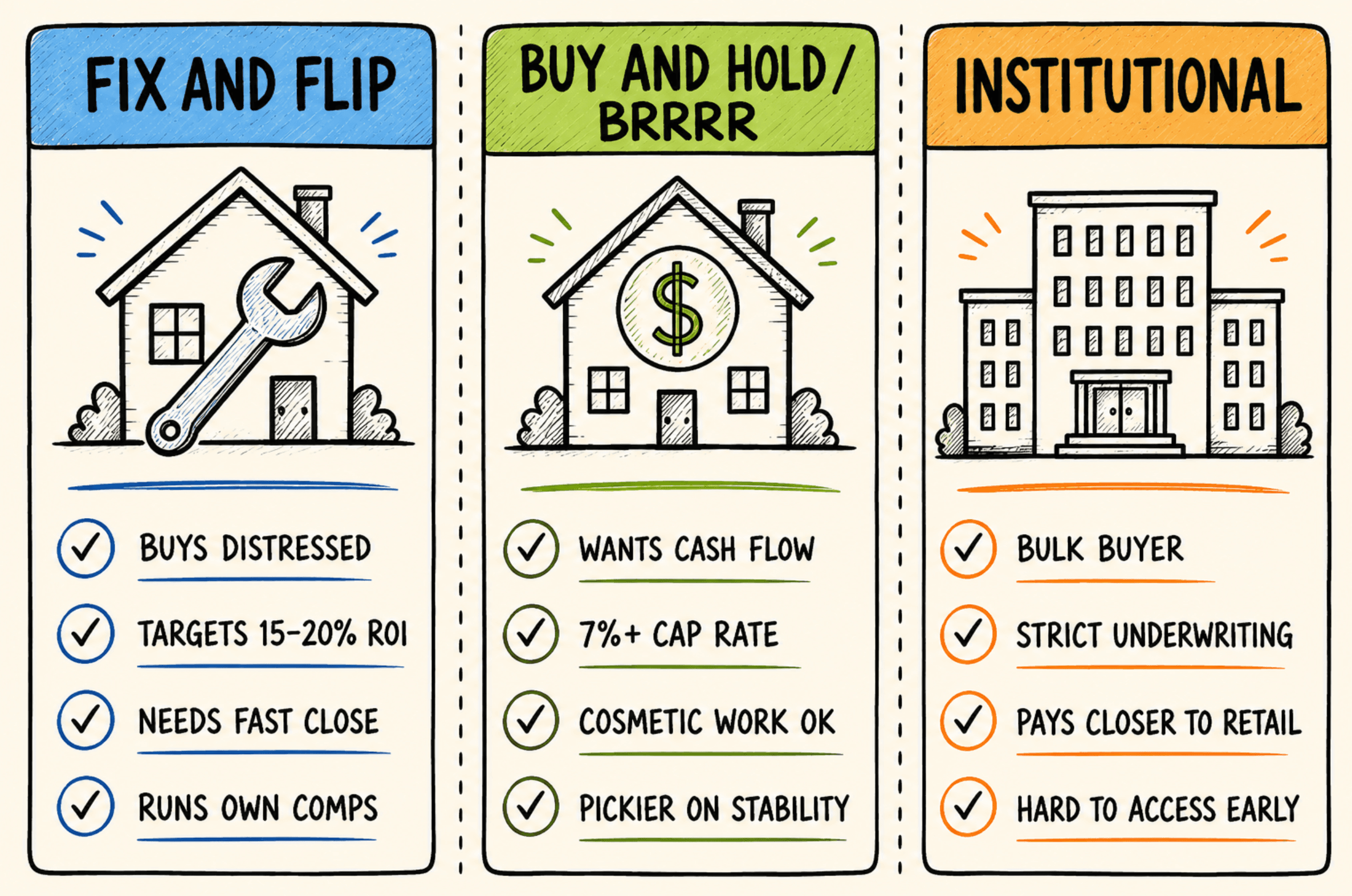
Step 1: Sort buyers into three types
Fix and flip investors chase 15-20% ROI after carrying costs, need to close fast, and run their own comps before committing.
Buy-and-hold landlords and BRRRR investors target 7%+ cap rate in stable 2026 markets, prefer cosmetic work over structural rehab, and move slower but more predictably.
Institutional buyers, hedge funds, iBuyers, bulk-acquisition teams, buy across zip codes with automated underwriting. Hard to reach early, worth building toward once volume picks up.
Start with flippers and landlords. Institutions come later.
Step 2: Pull real buyer data, not cold contacts
| Source | What you get | Cost |
|---|---|---|
| County records (manual) | Cash-purchase deeds, no mortgage attached | Free, time-heavy |
| PropStream / BatchLeads / Dispo Genius | Same data, filtered by zip and date, with contact info | Paid, minutes |
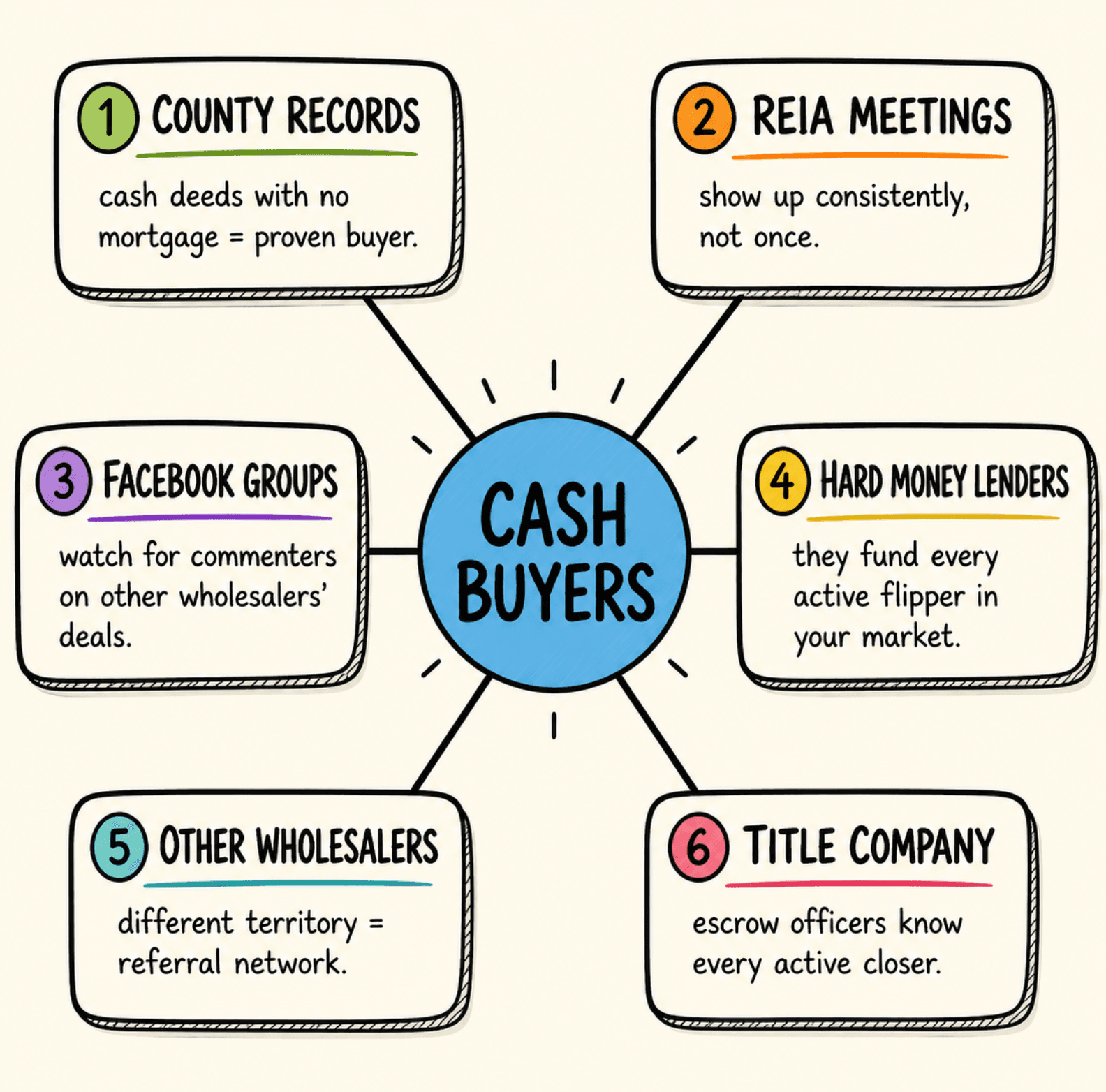
| REIA meetings | Direct relationships, no data pull needed | Free, slow to build |
| Hard money lenders | Warm introductions to active borrowers | Free, relationship-based |
| Title company | Local intel on who's closing and buying more | Free, relationship-based |
County records work because every cash sale records as a deed with no mortgage document attached, meaning the buyer paid outright. Manually, that's your county recorder's site, filtered for recent sales with no mortgage filing, then pulling buyer names to skip trace. In PropStream or BatchLeads, filter for cash sales, sort by close date, and export the contact list directly instead.
REIA meetings, Facebook investor groups, and hard money lenders round out the list. Watch Facebook for "interested" comments on other wholesalers' posts, that's a live buyer telling you exactly what they want.
Step 3: A small, proven list beats a big cold one
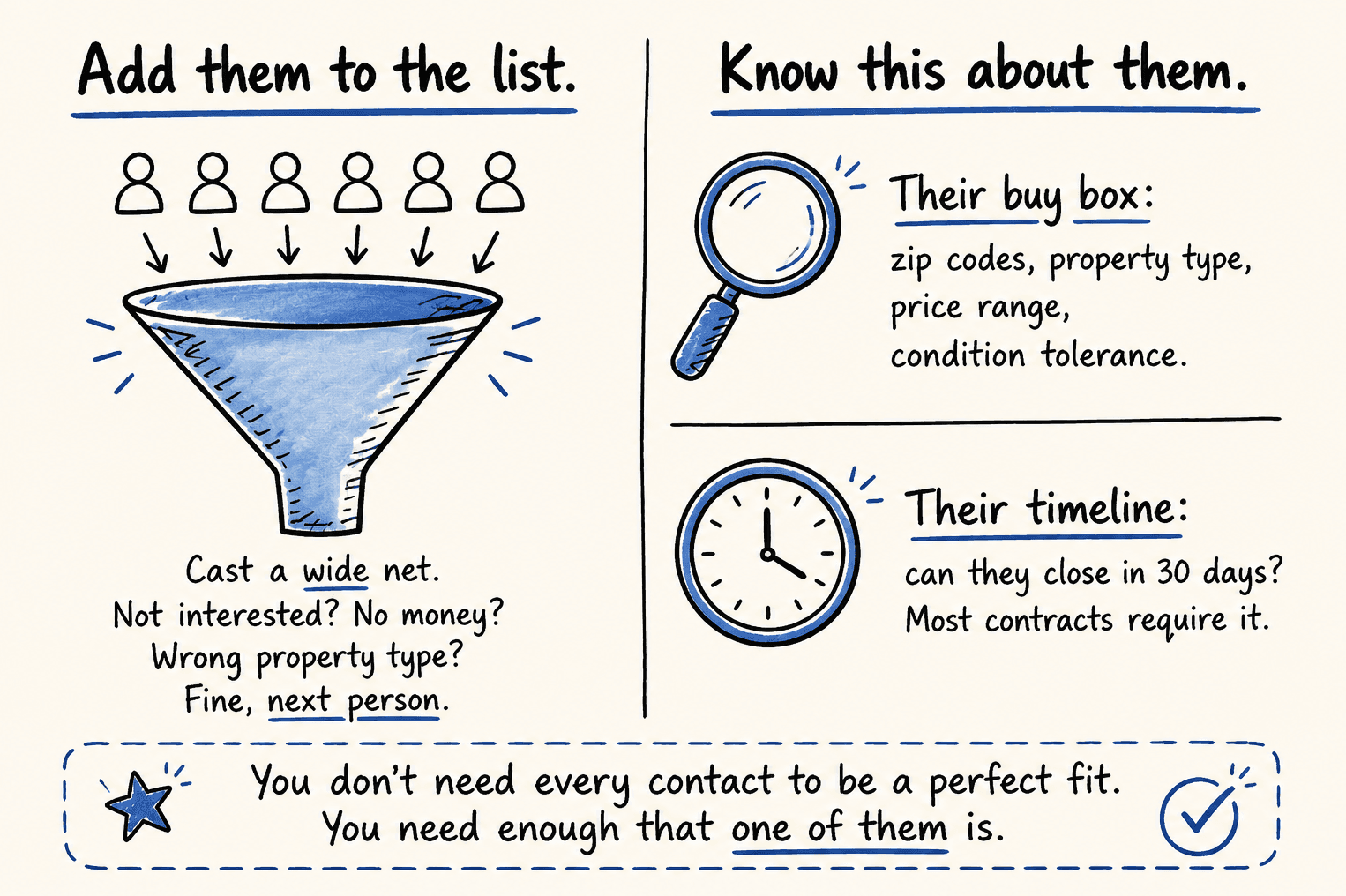
Say a $210K duplex in a landlord-friendly zip code lands in your inbox. A 300-name list scraped with no purchase history gets you a few dozen texts and maybe four replies, most of them not serious. Twelve buyers verified against a closing in the last six months gets you three names who already target that zip code and price band, called directly, offer accepted same day. Size didn't win that. Proof did.
Two things matter per buyer: their buy box (zip codes, price range, condition tolerance) and how they fund deals. A buyer who's closed three deals in your target zips in the last six months outweighs someone who took a course and handed you a business card, even if the second person sounds more eager. Timeline matters operationally too: most wholesale contracts close in 30 days, so a buyer needing 60 to arrange financing won't fit most of what you bring.
Where county records break down
Recorded deeds don't reflect a closing the same day it happens, most counties run behind by anywhere from days to weeks depending on staffing and volume, so the freshest buyers won't always show up yet. Skip tracing has a real cost per lead and a nonzero bad-number rate, budget for both. And a cash purchase alone doesn't confirm investor intent, some are owner-occupants paying cash. Cross-check against LLC ownership or a second purchase in the same zip code before assuming it's an investor.
Step 4: Package deals so buyers can say yes fast
Texting "got a deal, interested?" with a phone photo gets ignored. Serious buyers want address, asking price, ARV with comps, repair estimate, and the margin math up front. A one-page summary gets replies. A casual text doesn't.
Once buyers are on the list, ChatARV saves a profile per buyer, buy box, funding type, closing timeline, and flags matching deals automatically as they enter your pipeline, so you know who to call first instead of re-reading old notes.
FAQ
How many buyers do I actually need?
Fewer than most people think. A handful of active, funded buyers who close consistently, often somewhere between five and twenty depending on deal volume, beats two hundred cold names. Depth wins over size once you have a few proven closers.
Should I buy a pre-made cash buyers list?
Bought lists are almost always stale and shared with other wholesalers. Paying for tools like PropStream to pull your own county-record data is different, and worth it. Paying for someone else's contact list rarely is.
How do I know if a buyer is actually serious?
Ask about their last three closings, address, price, funding source. Real buyers answer specifically. No purchase history in the last six months is the clearest signal to deprioritize them.
Match deals to buyers without rereading old notes
ChatARV saves a profile per buyer — buy box, funding type, closing timeline — and flags matching deals as they enter your pipeline.