Hard money loans have a reputation for being expensive and intimidating. They are expensive. But for the right deal and the right investor, they're often the type of funding that will make your deal most profitable - and sometimes the only type that will make the deal work.
Here's what hard money loans actually are, what they cost in 2026, how the draw process works, and when using one makes sense versus when it doesn't.
What a hard money loan is
A hard money loan is a short-term, asset-based loan funded by private lenders or lending companies rather than banks. The term "hard money" refers to the hard asset, the property, that secures the loan. The lender is primarily underwriting the deal, not you.
That distinction is the whole point. A conventional mortgage lender wants your tax returns, W-2s, employment history, and debt-to-income ratio. A hard money lender wants to know what the property is worth, what it'll be worth after renovation, and how you plan to exit the loan. Your personal income matters a lot less than the deal math.
This makes hard money useful in situations where conventional financing is too slow, won't work for the property type, or won't approve an investor who looks complicated on paper.
What hard money loans cost in 2026
Hard money is not cheap. You need to know exactly what you're paying before you use it.
Interest rate
Hard money interest rates in 2026 generally run between 9.5% and 12.5% depending on LTV ratio, property type, borrower experience, and market. Some lenders go higher for riskier deals or less experienced borrowers. These are interest-only loans — your monthly payment covers only the interest, not the principal. The full loan balance is repaid at the end of the term via sale or refinance.
Monthly interest on a $200,000 loan at 11%: $200,000 × 0.11 ÷ 12 = $1,833 per month.
Origination points
Points are a one-time fee charged at closing, expressed as a percentage of the loan amount. The industry standard in 2026 is 1.5 to 3 points. On a $400,000 loan, expect to pay $6,000-12,000 in origination fees. One point on a $200,000 loan = $2,000.
Other fees
Beyond interest and points, budget for: appraisal or valuation fee ($400-600), draw inspection fees ($150-250 per draw on renovation projects), document preparation and processing fees ($500-1,500), and title insurance. These vary by lender; get a full fee sheet before you commit.
The total cost on a real deal
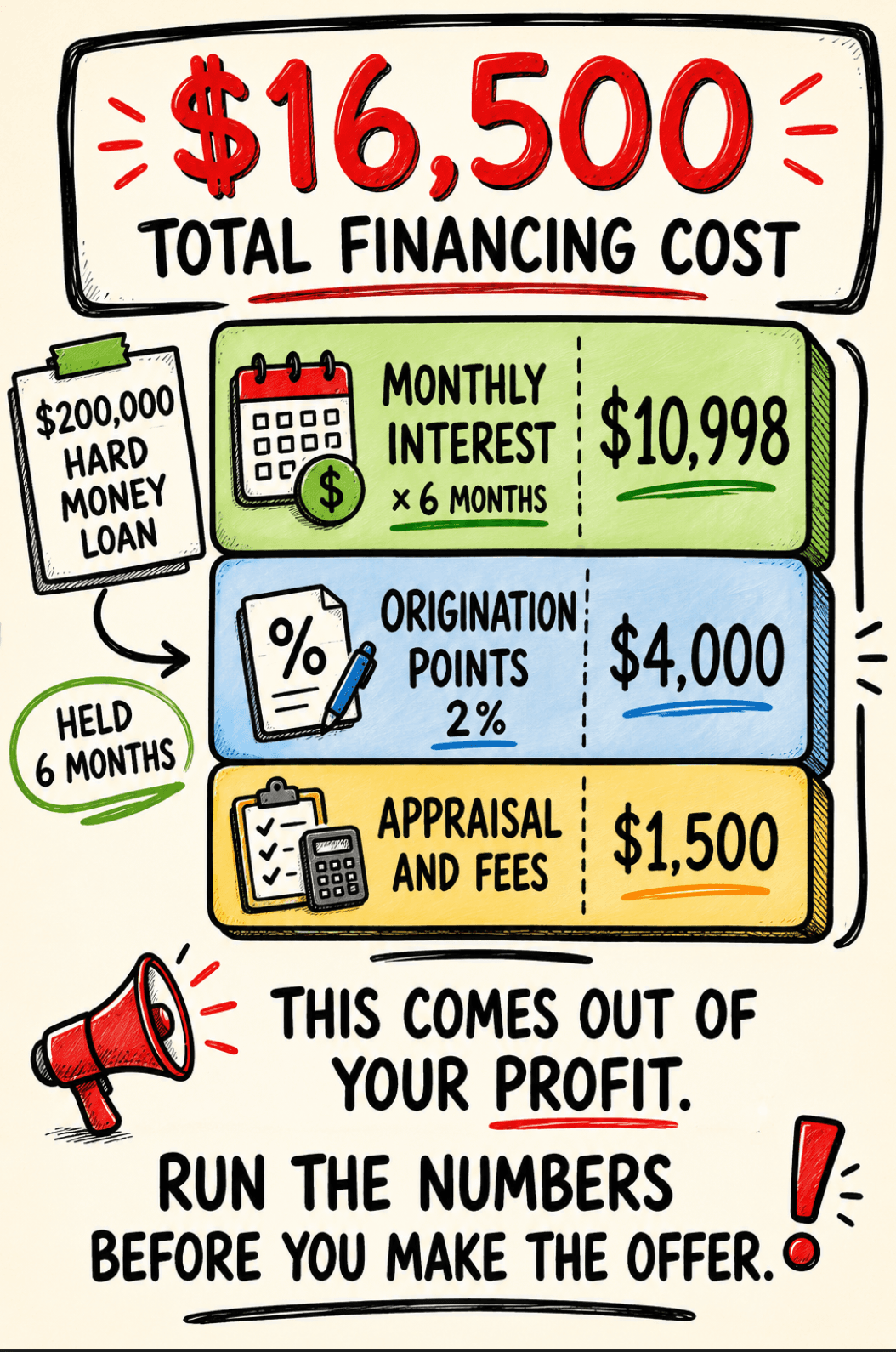
Example: $200,000 hard money loan at 11% interest, 2 origination points, 6-month hold.
Monthly interest: $1,833 × 6 months = $10,998
Origination points: $4,000
Appraisal + fees: ~$1,500
Total financing cost: ~$16,500
That $16,500 needs to come out of your profit. It needs to be in your deal analysis before you make an offer, not discovered after you've closed.
If you're using ChatARV, Express Capital Financing is available as a perk in your account. They're a hard money lender with over $1b in funded projects and offer ChatARV members a $250 closing credit. Worth checking before you shop lenders.
How the loan structure works
Hard money loans on renovation deals typically have two components: an acquisition loan and a rehab holdback.
The acquisition portion funds your purchase and closes with the property. The rehab holdback is the renovation budget, held by the lender and released in stages as work is completed. You don't get all the renovation money at closing; you get it draw by draw as the work progresses.
The draw process
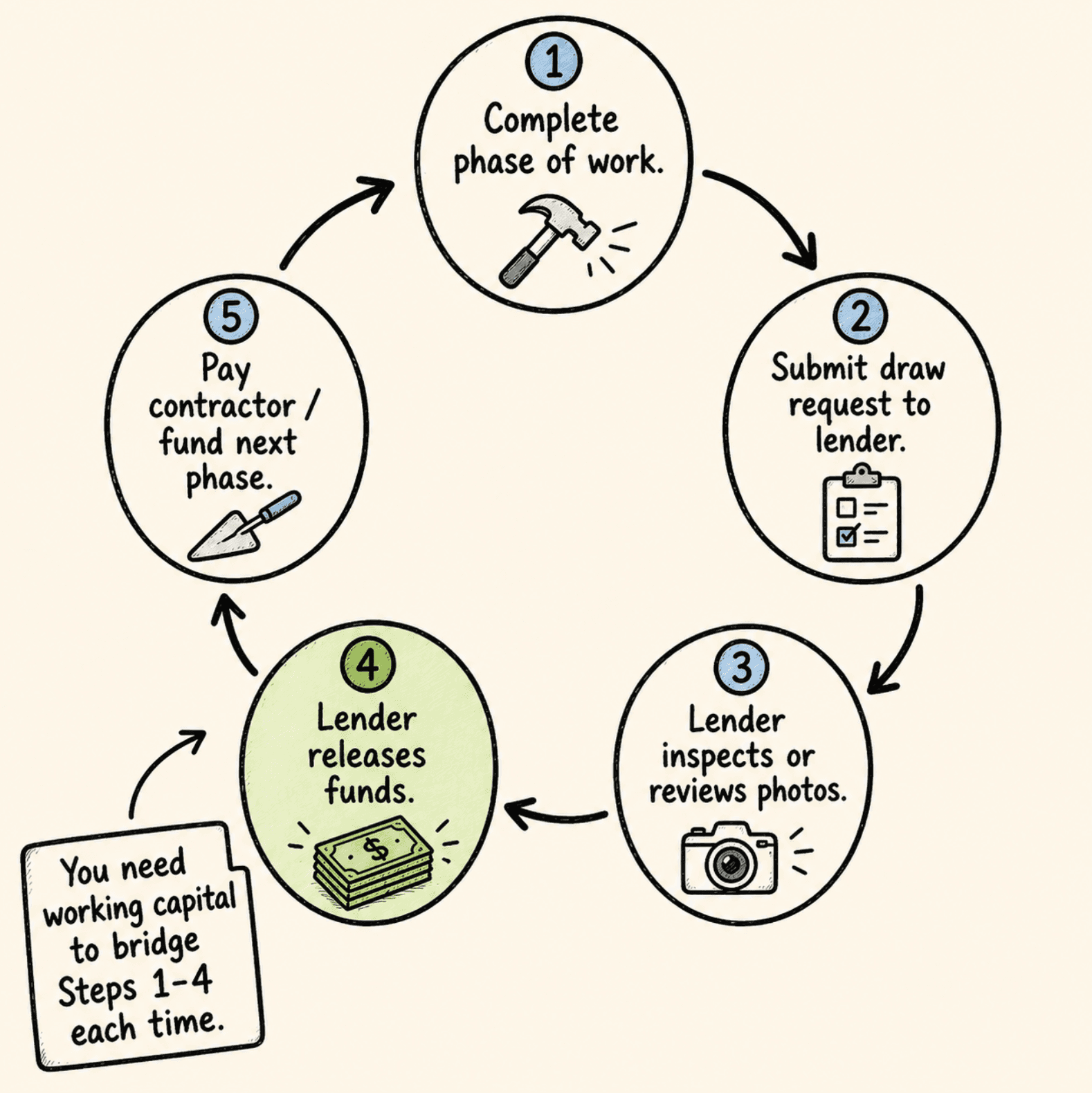
A draw is a scheduled release of funds from the rehab portion of your loan. After you complete a phase of work, you request a draw from the lender. The lender verifies the work and releases the corresponding funds. This structure protects the lender by ensuring money only goes out after work is actually done.
The practical implication: you need working capital beyond your down payment. You pay the contractor, the work gets done, you request the draw, the lender inspects, and then you get reimbursed. Running out of working capital between draws is one of the more common cash flow problems investors face during rehab projects.
One important detail: most lenders charge interest only on funds actually disbursed. As you take draws, your loan balance and monthly payment grow. Some lenders charge on the full approved amount from day one, which is significantly more expensive. Confirm which method your lender uses before you sign.
Loan terms and LTV
Most hard money loans run 6-18 months. 12 months is the most common term for fix-and-flip deals. Extensions are available but cost money, typically an additional fee and sometimes a rate increase.
LTV on acquisition typically runs 65-75% of purchase price or ARV depending on the lender's program. On renovation deals, the total loan-to-cost (acquisition plus rehab) is usually 70-80% of ARV after repairs. That gap between the loan and the total project cost is your skin in the game, the cash you put in.
Credit requirements are more flexible than conventional financing. Most lenders want at least a 600-620 credit score, though some work with lower scores on strong deals. Your track record matters more as you do more deals, experienced borrowers with clean exits get better terms.
When hard money makes sense
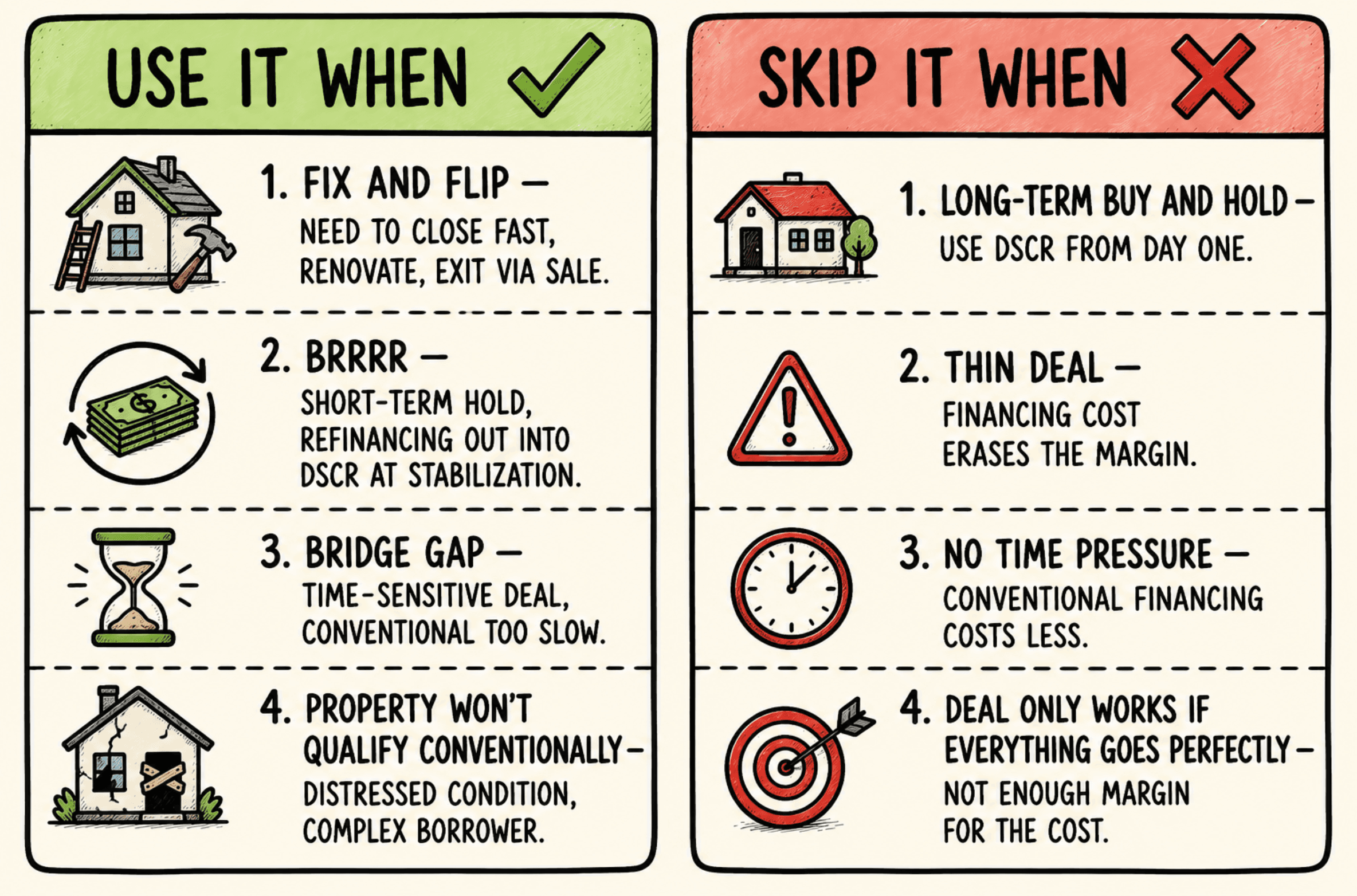
Fix and flip. The primary use case. You need to close fast to compete with other buyers on an off-market deal, you're renovating the property and need renovation draws, and you're exiting via sale, not a mortgage. Hard money is designed for this.
BRRRR acquisition. You buy a distressed property, renovate it, and refinance into a DSCR loan once it's stabilized and rented. Hard money funds the purchase and rehab; the DSCR loan pays it off. The high cost is temporary; you're holding it for 6-8 months, not 30 years.
Short-term bridge needs. You need to close on a new property before your existing one sells, or you need to act quickly on a time-sensitive deal before traditional financing can close. Hard money closes in 7-14 days. Conventional loans take 30-45 days minimum.
Deals that don't qualify for conventional financing. Distressed properties with condition issues that conventional lenders won't touch. Properties that need significant work before they'd pass an appraisal. Investors with complex tax returns or multiple financed properties that bump against conventional limits.
When hard money doesn't make sense
Buy and hold rentals you plan to keep long-term. Hard money is meant to be temporary. If your exit strategy is to hold the property indefinitely as a rental, you need permanent financing from day one, a DSCR loan or conventional investment property mortgage. Using hard money on a long-term hold is just burning money on interest every month with no defined payoff event.
When the deal barely works at lower financing costs. If your projected profit is $15,000 and your hard money costs are $16,500, the math already doesn't work. Hard money reveals thin deals. A deal that requires everything to go perfectly on a tight timeline to be profitable isn't a deal, it's a bet.
When you have time. If you don't need to close in 7-14 days and the property would qualify for conventional investment financing, the cost difference is significant. Hard money at 11% versus a DSCR loan at 6.5-7.5% on a 12-month hold on a $200,000 loan is roughly $7,000-8,000 in extra interest. Use conventional financing when you can.
Building hard money costs into your deal analysis
Hard money costs belong in your deal analysis before you make an offer, specifically as part of your total holding cost calculation that feeds into your maximum buy price.
For a flip: the formula is ARV times your target discount, typically 65-75% depending on the market, minus repair costs, minus total holding costs including all hard money interest and points for the projected hold period. That equals your true maximum buy price. ChatARV runs this automatically from actual comps, so you're working with real numbers instead of guessing the percentage.
For BRRRR: the hard money carry costs reduce the net cash you get back at refinance. A deal that produces $45,000 in cash-out after the DSCR refinance is a different deal after $16,500 in hard money costs.
Questions to ask every hard money lender before you commit
These are the questions most beginners skip that most experienced investors ask immediately:
Do you charge interest on the full loan amount from day one, or only on disbursed funds? A lender charging on the full amount from day one is more expensive than one charging only on drawn funds.
What's the draw inspection process and timeline? If each draw takes 10 business days to process, you'll need to cover renovation costs out of pocket until reimbursement comes through. On a four-draw renovation that can mean floating $10,000 or more at a time. Factor that into your cash reserves.
Are there prepayment penalties? Some lenders charge a minimum interest period even if you exit early. If you sell the flip in four months on a 12-month loan, you might owe six months of interest anyway.
What happens if I need an extension? Renovations run over. Know the extension terms and cost before you need them.
What documentation do you need? Some lenders require a full scope of work and contractor agreements before closing. Others need very little. Know what's required so you can close on the timeline you need.