If you own rental properties, or you're trying to, you've probably run into the wall conventional loans put in front of investors. Too many financed properties. Tax returns that make you look broke on paper because you write everything off. A Debt-to-Income Ratio (DTI) that blows up the moment you try to add a third deal.
DSCR loans exist specifically to solve that problem. They don't care what your W-2 says. They care whether the property pays for itself. Here's exactly how they work and what you need to qualify in 2026.
What DSCR means and how it's calculated
DSCR stands for Debt Service Coverage Ratio. It's a single number that tells a lender whether a rental property generates enough income to cover its own loan payment.
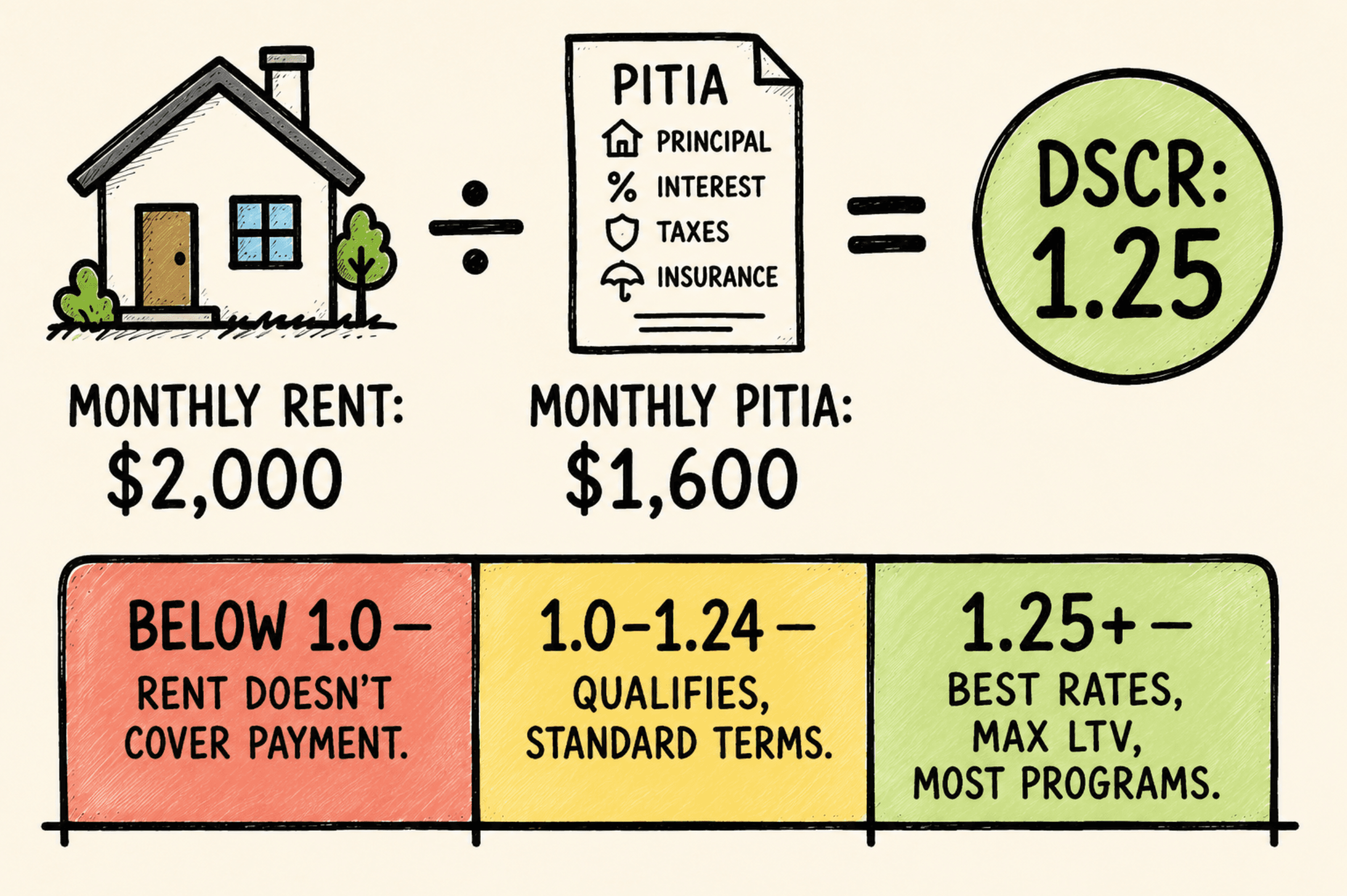
The formula: Monthly rent ÷ Monthly PITIA = DSCR
PITIA stands for Principal, Interest, Taxes, Insurance, and Association fees, everything that makes up the monthly payment obligation on the loan.
A DSCR of 1.0 means the property breaks exactly even. Rent covers the payment, dollar for dollar. A DSCR of 1.25 means the property generates $1.25 for every $1.00 it costs to carry. A DSCR below 1.0 means rent doesn't cover the payment, the owner is making up the difference out of pocket.
Worked example: monthly rent $2,000, monthly PITIA $1,600. DSCR = 2,000 ÷ 1,600 = 1.25.
One thing that surprises a lot of investors: only taxes, insurance, and HOA dues are included in the PITIA denominator. Repairs, maintenance, vacancy, utilities, and property management fees are not factored in by the lender. That makes DSCR qualification cleaner, but it also means you should run your own numbers separately to know whether the property actually cash flows for you after all those real costs.
Why DSCR loans matter for investors specifically
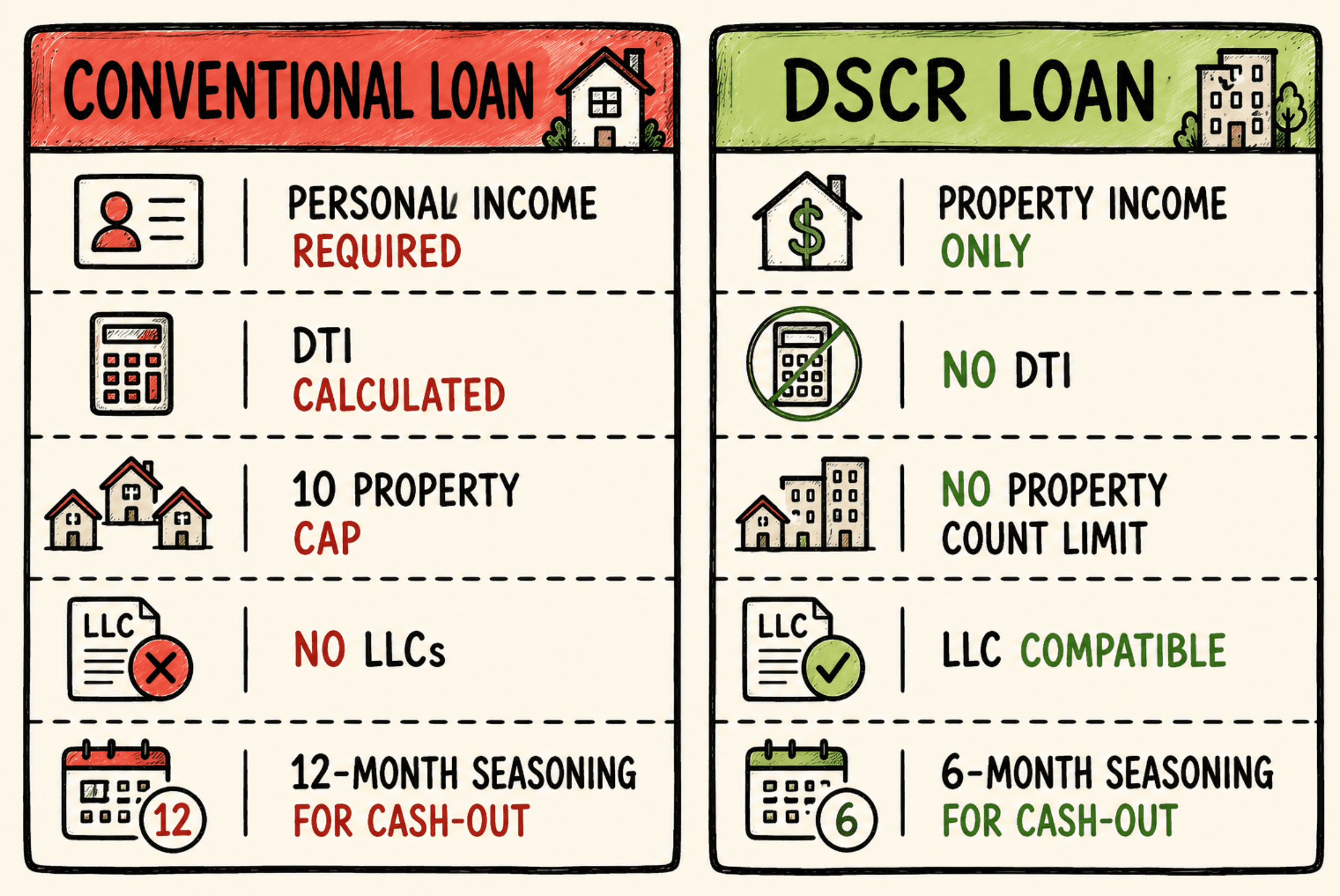
Conventional mortgages are built for homebuyers, not investors. They require personal income documentation, cap the number of financed properties at ten, don't work inside an LLC, and since April 2023 require a full 12 months of ownership before a cash-out refinance on investment properties.
BRRRR, Buy, Rehab, Rent, Refinance, Repeat, is the strategy where you buy a distressed property with short-term financing, renovate it, rent it out, then refinance into a long-term loan and pull your capital back out to do it again. That last step is what made DSCR loans essential for BRRRR investors. When Fannie Mae updated guidelines in 2023 to require 12 months of seasoning for cash-out refinances, DSCR loans became the preferred option. The distinction isn't just that DSCR is an alternative; it's that it aligns with how BRRRR actually operates.
DSCR loans have no personal income requirement, no DTI calculation, no property count limit, are fully compatible with LLC ownership, and allow cash-out refinancing after 6 months rather than 12. For investors running multiple properties or writing off significant income on their taxes, this is the only path that scales.
The core requirements in 2026
DSCR ratio
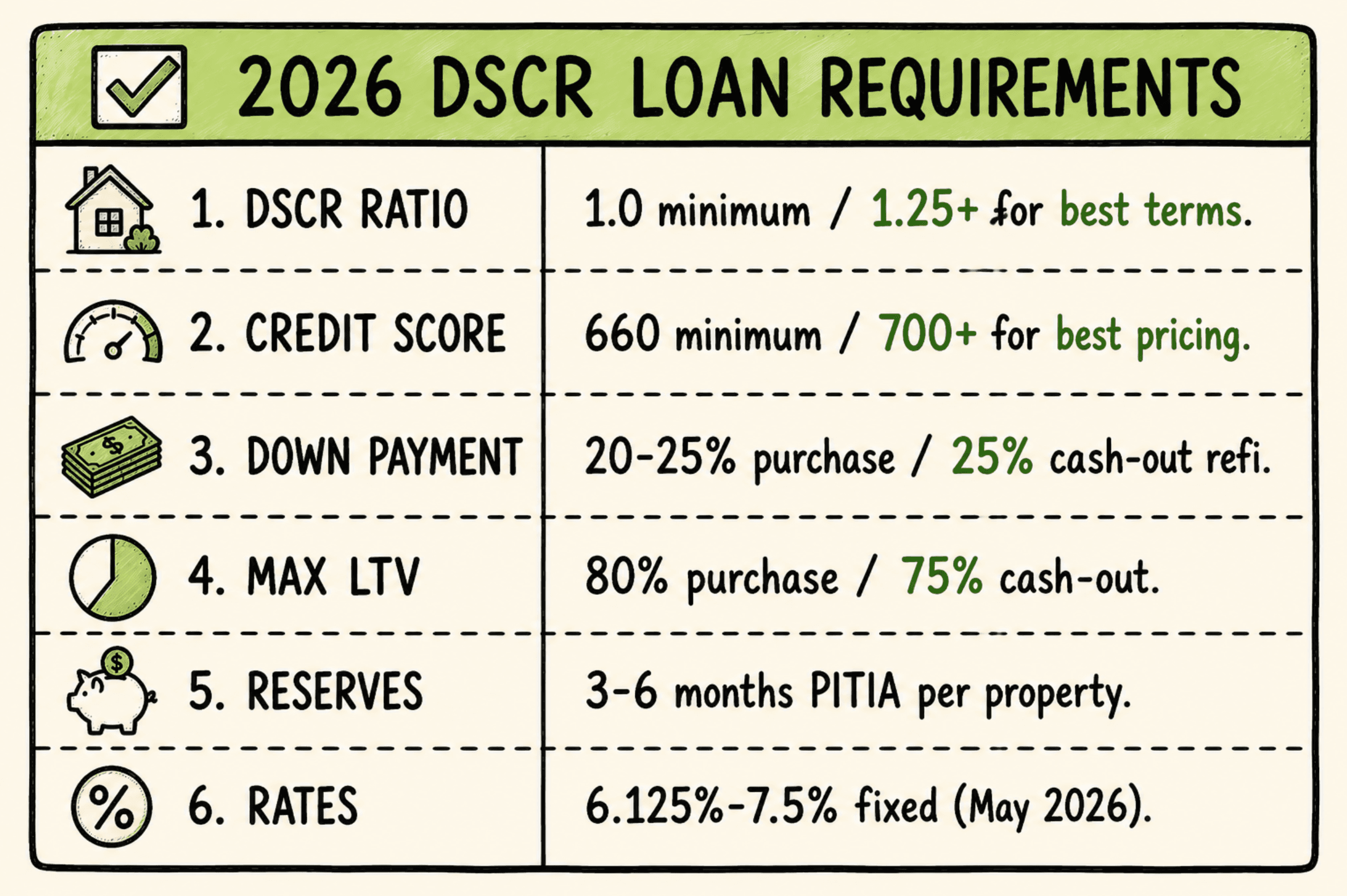
Most lenders require a minimum DSCR of 1.00, with 1.25 or higher unlocking the lowest rates and maximum leverage. Some programs accept as low as 0.75 with compensating factors. A handful of lenders offer no-ratio programs with no minimum DSCR, but those come with higher rates and lower LTV.
The practical target: aim for 1.25. It qualifies at most programs, unlocks the best pricing, and confirms the property actually cash flows after debt service.
Credit score
Most lenders require a minimum FICO score of 660 to qualify for a DSCR loan. A higher LTV of 80% may require 700 or above. In 2026, lender overlays have tightened, even when the base program allows 620, many lenders have added their own requirements of 660 or 680 for certain property types or LTV ratios.
The practical target: 700+ gives you access to the best programs, best rates, and highest LTV options. Between 660 and 700 you can still qualify but with more restrictions. Below 660 you're looking at harder-to-find programs with worse terms.
Down payment and LTV
For purchases: 20-25% down is standard. 20% down (80% LTV) is available with 700+ credit, DSCR above 1.25, and single-family or 2-4 unit properties. 25% down (75% LTV) is the standard requirement for most borrowers. 30-35% down is required for lower credit scores, sub-1.0 DSCR scenarios, or short-term rental properties.
For cash-out refinances: maximum LTV is 75% on most programs. Rate-and-term refinances can go to 80% LTV.
Reserves
DSCR lenders require cash reserves equal to 3-6 months of PITIA per financed property. For a property with a $2,000 monthly PITIA, expect to show $6,000-12,000 in liquid reserves, bank statements, retirement accounts (partial), or money market balances all count. Reserves scale up as your portfolio grows and as deal risk increases.
Rates
Fixed DSCR loan rates in May 2026 range from 6.125% to 7.5% depending on buydown points, credit score, DSCR ratio, down payment, and prepayment penalty term. Adjustable-rate options start lower. The right question isn't what the rate is; it's whether the deal still cash flows at that rate. A property generating 1.25 DSCR at current rates has sound fundamentals regardless of where rates sit relative to 2021.
Loan amounts
Most programs start at $100,000-150,000 and top out at $1-3 million for standard residential. Jumbo DSCR programs go higher. Below the minimum, most lenders won't originate.
Seasoning for cash-out refinances
This is the question BRRRR investors care about most: how long do you have to own the property before you can refinance and pull cash out?
Seasoning requirements vary significantly by lender: some have no seasoning requirement at all, others require 3-6 months, some require 6-12 months, and a few require the full 12 months before cash-out is permitted.
The most common threshold is 6 months. That aligns well with a BRRRR timeline: close on acquisition, renovate over 3-4 months, get a tenant in place, wait out the seasoning period, apply for the refinance. A well-executed BRRRR with DSCR looks like: purchase in month one, renovate through months one to three, list and lease in month three or four, stabilize with a paying tenant by month five, apply for DSCR cash-out refinance at month six, close in month seven or eight.
One exception worth knowing: if you bought the property all cash with no mortgage, no seller financing, and no personal loans secured by the property, you may qualify for the delayed financing exception — which allows a cash-out refinance immediately after purchase without any seasoning period. Confirm this with your lender before structuring a deal around it.
Property types that qualify
Most DSCR programs cover single-family homes, 2-4 unit properties, condos, and townhomes. Some extend to 5-10 unit small multifamily. Short-term rentals are accepted by a growing number of lenders using AirDNA projections or comparable STR appraisals rather than long-term lease income, typically requiring 12-24 months of STR operating history or a market-rate appraisal.
Properties that don't qualify for most DSCR programs: primary residences (DSCR is investment-only), properties under $100,000 in value, rural properties in very low-activity markets, and certain non-warrantable condos. Commercial properties require different loan structures.
DSCR and the BRRRR calculator
For BRRRR investors, DSCR isn't just a loan product; it's the qualification number that determines whether the refinance works and how much capital comes back out. A property with a 1.0 DSCR qualifies for the refinance but at lower LTV and worse terms. A property at 1.25 unlocks the full 75% LTV and best pricing. Whether you clear that threshold depends on how well you bought, how well you rehabbed, and what you're able to charge in rent.
ChatARV's free BRRRR calculator calculates DSCR automatically alongside ARV, refinance proceeds, and cash-out projections, so you know before you make the offer whether the deal will support the refinance you need.
The things that kill DSCR refinances after you thought everything was fine
Attempting the cash-out before the seasoning period. Seasoning is the minimum time a lender requires you to own the property before they'll approve a cash-out refinance, typically 6 months for DSCR lenders. Even if the property is fully renovated and rented, if you apply before that window closes the refinance either gets denied or forced into a more restrictive loan structure. Confirm the exact seasoning requirement before you close on the purchase, not when you're ready to refinance.
Rent below market. DSCR uses the lower of actual rent or appraiser's market rent estimate. Pricing a tenant into the property below market to fill it fast compresses the DSCR ratio used for qualification. The same problem applies if the appraiser's market rent comes in below what you're charging; your qualifying income drops to the appraiser's number.
Hidden liens. Unpaid property taxes, HOA arrears, or a mechanic's lien surface during title work and delay or kill the closing. A preliminary title check before you start the refinance process saves significant time.
Inadequate reserves. Showing up to a DSCR refinance without enough liquid reserves in your bank account stalls the deal. If you pulled all your cash into the renovation and haven't replenished reserves, the lender may decline regardless of how good the property looks.