
Real Estate Deal Analyzer: Comps, ARV & Offers Fast
ChatARV is a real estate deal analyzer that finds comps, calculates ARV, estimates repairs, and generates offers in about 60 seconds. Try it free.

A real estate deal analyzer is the tool that separates investors who close deals in minutes from those who lose them to slower competitors. Instead of spending 20 to 30 minutes digging through listings, spreadsheets, and gut-feel comps, a dedicated analyzer pulls comparable sales, calculates After Repair Value (ARV), and builds a ready-to-use offer in about a minute. For wholesalers and investors, that speed difference often decides who gets the signed contract.
What Is a Real Estate Deal Analyzer?
A real estate deal analyzer is a software platform that reviews recent property sales, adjusts for differences in size and condition, and outputs a valuation range an investor can act on immediately. Most tools also calculate repair costs and exit-strategy numbers like Maximum Allowable Offer (MAO), flip profit, and buy-and-hold cash flow.
Traditionally, this work fell to agents, appraisers, or the investor themselves, sorting through MLS listings and public records by hand. That process is slow, and it's inconsistent — two people analyzing the same property often land on different numbers depending on which comps they chose. As a result, a dedicated analyzer removes that variability by applying the same weighting logic (proximity, recency, condition) to every property, every time. For a deeper look at how ARV specifically gets calculated, the ARV calculator guide walks through the full formula.
A real estate deal analyzer turns raw comps into a usable ARV range in minutes.
Why Speed Matters More Than Ever in Property Investing
In wholesaling, speed is money. Specifically, the investor who gets a confident, defensible number to the seller first is usually the one who gets the contract. Meanwhile, traditional comping is slow and depends heavily on who's doing it — pull the wrong comps and an investor either overpays and kills the margin, or lowballs and loses the deal entirely.
Consider what that competitive gap actually looks like in practice. According to Investopedia, ARV is one of the core inputs real estate investors use to set repair budgets and offer prices, yet manual calculation is prone to human error. Because a real estate deal analyzer automates that math, investors can run the numbers while still on the phone with a seller instead of promising a callback. As one daily ChatARV user, Chris Turney of Fortis Valorem, puts it: "I'm on it every day… I can give sellers an offer on the same call." That same-call advantage is frequently what separates a signed contract from a missed opportunity.
How a Real Estate Deal Analyzer Works, Step by Step
Although every platform is built a little differently, most real estate deal analyzers follow the same basic sequence from address to offer. Here's how that process typically plays out:
- Enter the property address. Type in any property address, and the analyzer begins pulling public records, MLS-sourced data, and recent sales history within seconds, with no manual spreadsheet work required.
- Review the comps and adjustments. The tool surfaces the top comparable sales, weighted by proximity, recency, and condition, then automatically adjusts for square footage, bedroom and bathroom count, and lot size.
- Get the ARV and as-is value. Within about 60 seconds, the system calculates the after repair value range and the current as-is value based on those adjusted comps.
- Estimate repairs and generate an offer. Input or confirm the repair scope, and the analyzer calculates MAO, flip profit, buy-and-hold cash flow, and BRRRR projections for each exit strategy.
- Share or revise the report. Export the comp report for sellers and cash buyers, or update repair estimates after a walkthrough so every number recalculates instantly.
Notably, deals change after the walkthrough. When Chris Turney discovered a property needed a full gut renovation, he updated the report and it recalculated to $88,000 instantly — and he used that analysis to renegotiate and land a $35,000 assignment fee. To see how that offer-building step fits into a full wholesale workflow, the guide on how to make offers on wholesale deals covers it in more depth.
Key Features of a Reliable Property Valuation Tool
Not every comping tool is built the same way, and the differences matter once real money is on the line. Therefore, before trusting any platform with an offer price, it helps to check for a few core capabilities:
- Weighted comp selection — surfaces the best matches by proximity, recency, and condition instead of a flat radius search.
- Automatic adjustments — accounts for square footage, bed/bath count, lot size, and condition differences between the subject property and each comp.
- Full exit-strategy breakdown — covers wholesale MAO, novation, fix-and-flip, buy-and-hold, and BRRRR in a single report.
- Non-disclosure state support — still produces usable comps in states where sale prices aren't public record.
- Editable comps and repair scope — lets the investor toggle, swap, or add comps and recalculate after new information comes in.
ChatARV: A Real Estate Deal Analyzer Built for Wholesalers
ChatARV is purpose-built for wholesalers and investors — not a generic agent tool with investor features bolted on. Every report is designed around the one question that matters most: what should the offer be? Reports show the ARV range, the comps used, and every adjustment applied, so the number can be defended to sellers, buyers, and partners alike.
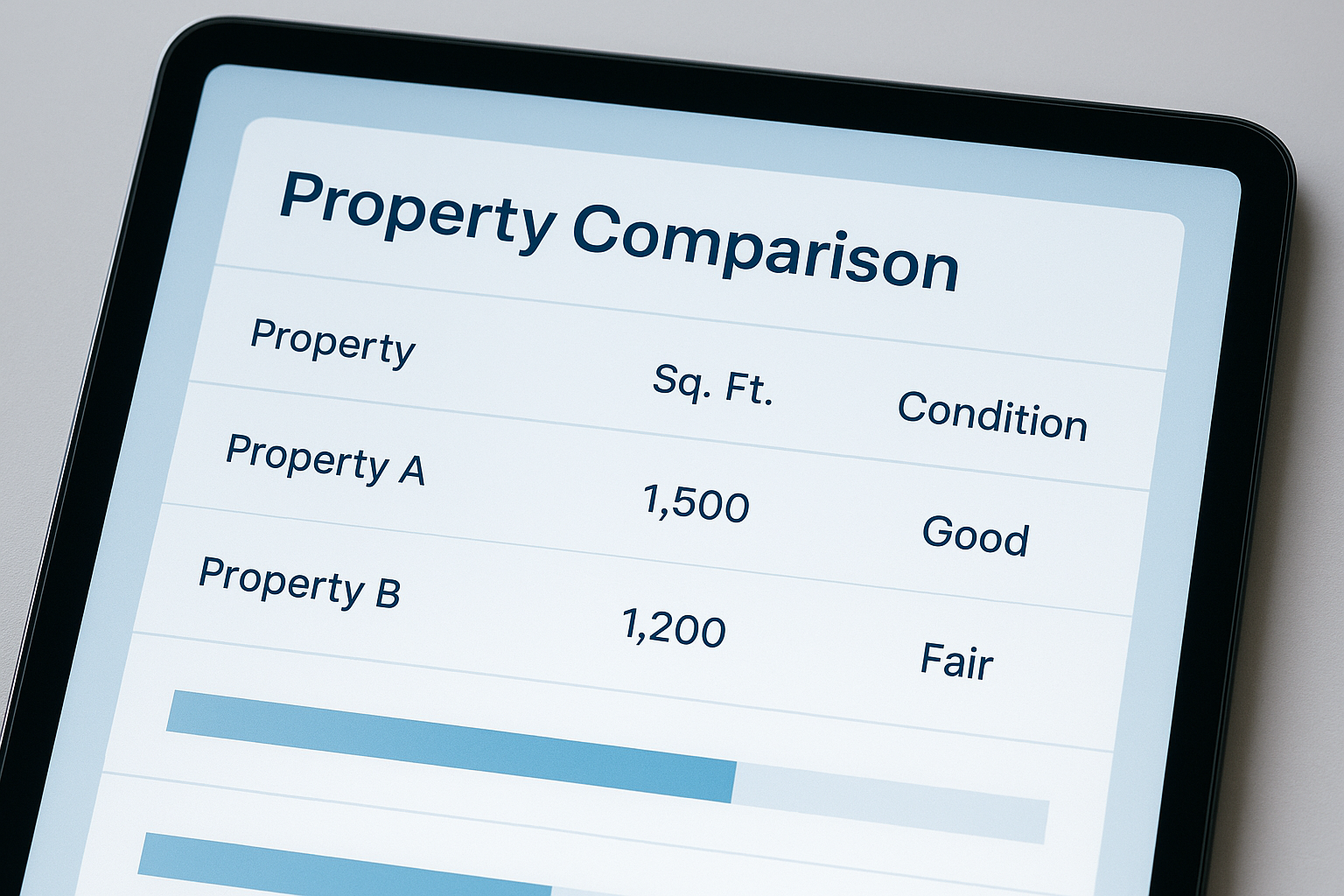
A real estate deal analyzer report breaks down exactly which comps shaped the ARV.
ChatARV is currently used by more than 20,000 active investors across the U.S., including non-disclosure states where sale prices aren't publicly listed. "It's all about time efficiency for me," says Samira Hassan of Hassan Investment Group. Similarly, Jio Francois of MLJ RE Investments notes how central the tool has become to daily deal flow. Beyond comps, investors also use the platform's AI to generate property listing descriptions, cutting even more busywork out of marketing a deal once it's under contract.
Real Estate Deal Analyzer vs. Manual Comping
Manual comping isn't necessarily wrong — it's just slow, and it leans heavily on the experience of whoever is pulling the numbers. In contrast, a dedicated analyzer applies consistent logic across every property, which means a newer investor can produce a report nearly as defensible as a seasoned one. For a side-by-side breakdown of where the two approaches diverge in speed, consistency, and coverage, see ChatARV vs. manual comps.
That said, automation doesn't remove the investor's judgment entirely. Specifically, an appraisal involves professional interpretation of market data, a concept explored in depth on Wikipedia's real estate appraisal overview. A good analyzer simply compresses the research phase so the investor can spend more time on negotiation and less on spreadsheets.
Common Mistakes to Avoid When Analyzing a Deal
Even with good software, a few recurring mistakes still show up in real estate deal analysis. First, using comps that are too old or too far from the subject property skews the ARV in either direction. Second, underestimating repair costs — especially on properties with hidden issues — eats directly into profit once the deal closes.
Third, and perhaps most costly, is simply moving too slowly. Because a seller on the phone is often talking to more than one investor, a delayed "let me run the numbers and call you back" can hand the deal to whoever responds first. Finally, failing to account for condition differences between the subject property and its comps — rather than just square footage — is one of the most common sources of a skewed valuation, a nuance even standards bodies like the U.S. Department of Housing and Urban Development address when discussing property condition in housing assessments on HUD.gov.

Fast, accurate numbers let investors make the offer before the seller hangs up.
Frequently Asked Questions About Real Estate Deal Analyzers
What is a real estate deal analyzer?
A real estate deal analyzer is software that automatically finds comparable property sales, calculates ARV and as-is value, and generates an investment offer for strategies like wholesaling, flipping, and buy-and-hold. It replaces hours of manual spreadsheet work with a report built in about a minute.
How does a real estate deal analyzer calculate ARV?
It pulls recent comparable sales near the subject property, then adjusts each comp for differences in square footage, bedroom and bathroom count, lot size, and condition. The adjusted comps are averaged into an ARV range the investor can use to set an offer.
Why do wholesalers need a deal analyzer instead of pulling comps manually?
Manual comping typically takes 20 to 30 minutes per property and produces inconsistent results depending on who runs the numbers. A deal analyzer applies the same weighting logic every time, so the ARV stays defensible and repeatable across every deal.
How fast can ChatARV analyze a property?
ChatARV typically delivers comps, ARV, as-is value, and an exit-strategy breakdown in about 60 seconds. That speed lets investors give sellers a real offer while they're still on the phone.
Can a real estate deal analyzer work in non-disclosure states?
Yes, though it depends on the data sources behind the tool. ChatARV supports all 12 U.S. non-disclosure states by pulling MLS-sourced transaction data across multiple providers, so investors don't need their own MLS access to run accurate comps.
What exit strategies does a deal analyzer typically support?
Most full-featured analyzers cover wholesale Maximum Allowable Offer (MAO), novation, fix-and-flip profit, buy-and-hold cash flow, and BRRRR projections. Some also include creative-finance structures for deals that don't fit a standard sale.
Is a real estate deal analyzer accurate enough to trust on every deal?
Accuracy depends on comp quality and how well the tool adjusts for property differences, but a well-built analyzer is more consistent than ad-hoc manual research. Even so, investors should review the comps used and adjust the repair scope after a walkthrough.
What's the difference between ARV and as-is value?
As-is value reflects what the property is worth in its current condition, while ARV estimates what it will be worth after renovations are complete. The gap between the two numbers, minus repair costs, is typically where flip and wholesale profit comes from.
Can I customize the comps a deal analyzer selects?
Many tools, including ChatARV, let investors toggle comps on or off, swap out a comp, or add their own custom comparable sale. This keeps the investor in control instead of fully trusting an automated selection.
What mistakes do investors make without a reliable deal analyzer?
Common mistakes include using outdated or distant comps, underestimating repair costs, and offering too slowly after a seller call. Each of these either kills margin through overpaying or loses the deal to a faster competitor.
How does a deal analyzer estimate repair costs?
It typically uses property condition data, square footage, and historical renovation cost benchmarks to generate a repair estimate, which the investor can then adjust after an in-person walkthrough. Updating the repair scope instantly recalculates the ARV and offer numbers.
How much does a real estate deal analyzer cost?
Pricing varies by platform and the volume of reports needed, ranging from pay-per-report tools to monthly subscriptions. Ultimately, investors should weigh the cost against the time saved and the deals won by making faster, more confident offers.
Can a deal analyzer help calculate the Maximum Allowable Offer (MAO)?
Yes, most wholesale-focused analyzers calculate MAO automatically once ARV, repair costs, and assignment fee targets are entered. This gives wholesalers a defensible number to present to sellers on the same call.
Final Thoughts on Choosing a Real Estate Deal Analyzer
Ultimately, a real estate deal analyzer isn't just a convenience — it's a competitive requirement in markets where the fastest, most confident offer tends to win the contract. Rather than spending half an hour on manual research per property, platforms like ChatARV compress comps, ARV, repair estimates, and a full exit-strategy breakdown into roughly 60 seconds. In addition, the ability to swap comps, update repair scope, and recalculate instantly means the numbers stay accurate even as a deal evolves after the walkthrough. For wholesalers and investors who can't afford to lose a deal to slow numbers, a reliable real estate deal analyzer turns that 20-to-30-minute bottleneck into something that happens before the seller finishes their coffee.